Profitability Decline for Businesses and Demand Decrease Due to Supply Surge
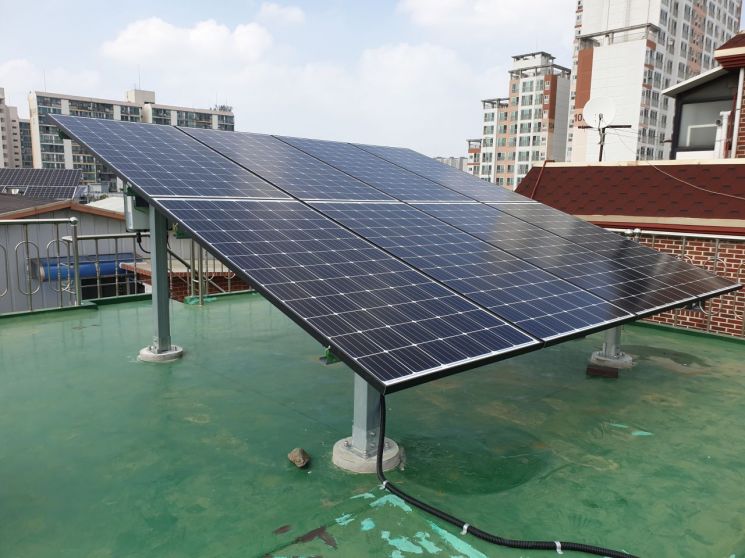
[Sejong=Asia Economy Reporter Kwon Haeyoung] The government is considering abolishing the 'Solar Power Equipment Rental Project,' a private sector-led model for residential solar power dissemination, after eight years since its introduction. Although the plan aimed to reduce dependence on government subsidies and promote market-driven expansion in increasing solar power adoption, the rapid increase in solar power equipment supply in recent years has adversely affected the profitability of the rental project. Critics argue that this is a side effect of the Moon Jae-in administration's energy transition policy, which seeks to rapidly increase the share of renewable energy such as solar and wind power instead of nuclear power generation.
According to the Ministry of Trade, Industry and Energy on the 25th, an internal discussion is underway to discontinue the solar power rental project starting next year. A ministry official stated, "As consumers prefer projects where they receive direct subsidies for solar power installation, the demand for equipment rental is decreasing," adding, "This year, the rental project will proceed as planned, but a decision on whether to abolish the system will be made around the end of the year."
The solar power rental project, introduced in 2013, is a system where private businesses selected by the Korea Energy Agency lease solar power generation equipment to residences and maintain and manage the equipment for 7 to 15 years. Homeowners can significantly reduce their electricity bills by paying rental fees for the solar power equipment, while rental businesses can earn rental income and sell Renewable Energy Certificates (REPs) received from renewable energy production to power companies. Unlike projects where the government, local governments, or public institutions partially support installation costs for solar and other renewable energy, this system has the advantage of no government subsidies and private sector-led expansion of solar power dissemination.
The Ministry of Trade, Industry and Energy is considering discontinuing the solar power rental project due to a sharp decline in demand. According to the Korea Energy Agency, new solar power rental project achievements increased annually from 60 households in 2013 to 10,362 households in 2016 and 19,077 households in 2018, but dropped to 12,067 households in 2019.
Excessive solar power supply has also reduced the economic viability of the rental project. The ministry limited the upper rental fee that rental businesses can charge consumers and encouraged them to cover profits by selling eco-friendly power generation certificates to power companies. However, as the amount of renewable energy that power companies are required to purchase in the market has not kept pace with supply, certificate prices fell from 211 to 258 KRW per 1kWh in 2018 to around 146 to 166 KRW this year.
Professor Jeong Dongwook of the Department of Energy Systems Engineering at Chung-Ang University said, "This is the result of the government focusing on expanding the supply of renewable energy such as solar power without properly designing the market for suppliers and consumers," adding, "Infrastructure was built mainly based on target allocations over the past four years, but it is now necessary to reestablish renewable energy dissemination strategies through precise market design."
© The Asia Business Daily(www.asiae.co.kr). All rights reserved.

















