Korean Brand 'Orollday' Faces Trademark Infringement in China
2,753 Korean Companies Suffer Trademark Theft in China
K-Pop Suffers from Copyright Infringement on Chinese YouTube
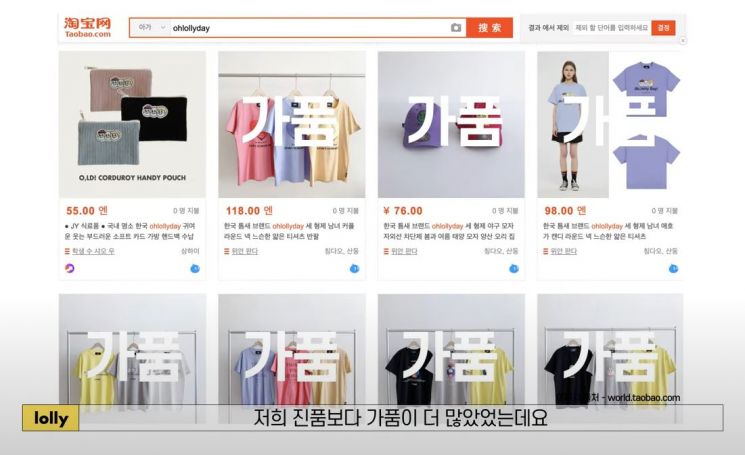 Counterfeit 'Oroliday' products posted on the Chinese e-commerce site 'Taobao'. Photo by YouTube channel 'Oroliday' screen capture.
[Asia Economy Reporter Heo Midam] Recently, China has been causing social issues by unauthorizedly using trademarks of South Korean companies. So-called 'trademark hunters' not only imitate domestic product designs exactly but also register trademarks first in China and then demand compensation by threatening Korean companies.
Citizens pointed out that China's 'cultural engineering' problem, where it claims Korean culture such as kimchi and hanbok as its own, is becoming more serious, urging the government to take active measures.
Recently, the domestic brand 'Oroliday' revealed that its trademark was stolen in China, causing a stir. Launched in 2014, Oroliday is a brand that sells various products such as eco-bags, hats, and diaries.
Oroliday appealed through its YouTube channel, saying, "In China, someone stole our brand and opened a store. The store's name is also Oroliday," adding, "All the content inside the store are counterfeit products made by copying our characters, slogans, and trademark names."
They continued, "Since China produces so many counterfeit products, we thought it was a situation we had to endure," but lamented, "Now, they not only make counterfeits but also registered our trademark and characters as if they were their own rights in China."
There were even cases where those selling counterfeit products threatened merchants dealing with genuine products. Oroliday stated, "Since last year, some sellers have started threatening genuine product sellers by saying, 'We are the trademark owners, so why are you selling products using our trademark without permission?'"
Eventually, Oroliday decided to file a trademark-related lawsuit against the merchants selling counterfeit products. However, it is reported that the costs required for litigation, application, and registration procedures amount to about 100 million KRW in the late range.
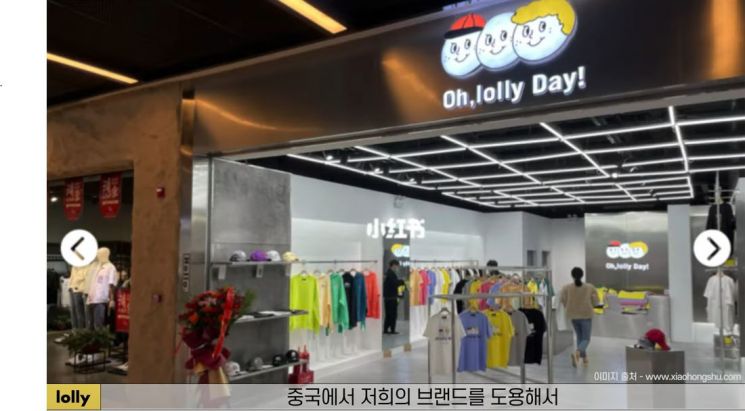 Unauthorized store opened in Qingdao, China without permission from 'Oroliday'. Photo by YouTube channel 'Oroliday' screenshot.
This is not the first time China's trademark infringement has been an issue. The bakery company 'Paris Baguette' also suffered damage due to China's counterfeit trademark 'Bari Baguette.' Additionally, the Korean dessert cafe 'Sulbing' faced headaches due to China's 'Sulbing Wonso,' which copied its logo and font exactly.
Such damage cases to Korean companies are also reflected in statistics. According to data submitted by the Korean Intellectual Property Office to Yoon Youngseok, a member of the National Assembly's Industry, Trade, Energy, Small and Medium Business Committee from the People Power Party, 2,753 Korean companies suffered trademark infringement damage in China last year. This is a 245% increase compared to 797 companies in 2019.
The problem is that despite frequent cases of Korean companies suffering from unauthorized trademark use in China, there are no adequate countermeasures. Especially, if a trademark is taken by others, the process of reclaiming the trademark is difficult. Even if litigation proceeds, it incurs huge costs and takes a long time, leading many to give up midway.
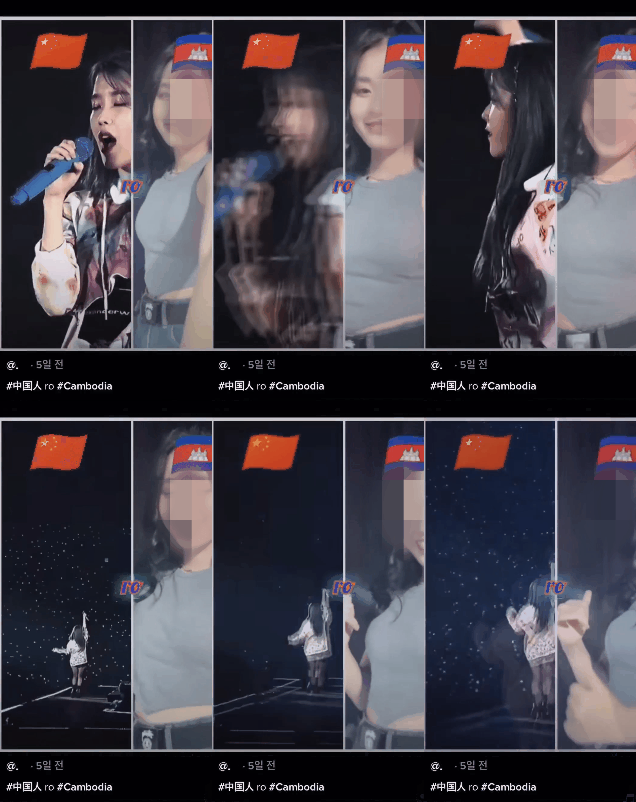 Video of IU uploaded on a Chinese 'TikTok' account. The Chinese national flag is displayed at the top of the video. Photo by TikTok screen capture.
As a result, citizens are outraged and urge the government to take active measures to protect the intellectual property rights (patent rights, copyrights, trademarks, etc.) of its nationals.
Office worker Kim (29) said, "I knew there were many counterfeit products in China, but I didn't expect them to blatantly target trademarks," criticizing, "Taking someone else's effort-filled results without permission is no different from theft." He added, "If such plagiarism continues in China, anti-China sentiment in our country will only worsen. I hope the government responds."
Meanwhile, there were cases where copyrights of some Korean songs were marked as belonging to 'Chinese companies.' Songs such as IU's 'Morning Tears,' Brown Eyes' 'Already One Year,' and Younha's 'Waiting' were unauthorizedly modified and sung by Chinese parties, then uploaded on YouTube with Content ID registered. As a result, royalties for neighboring rights of record producers and performers were distributed to Chinese record companies.
Regarding this, university student Jung (25) said, "China not only claims Korean culture like kimchi and pansori as its own but also blatantly lies by calling Korean singers Chinese singers, which is absurd," and raised her voice, saying, "Since such incidents occur frequently, the government should actively respond."
As the controversy grew, the Ministry of Culture, Sports and Tourism (MCST) expressed its intention to actively respond to such situations. The MCST plans to confirm the willingness of rights holders to respond, receive rights delegation, and cooperate with the Chinese copyright office through overseas copyright offices to consider measures against Chinese record companies.
© The Asia Business Daily(www.asiae.co.kr). All rights reserved.
![Clutching a Stolen Dior Bag, Saying "I Hate Being Poor but Real"... The Grotesque Con of a "Human Knockoff" [Slate]](https://cwcontent.asiae.co.kr/asiaresize/183/2026021902243444107_1771435474.jpg)

















