Sent a Strongly Opposed Official Letter to Nakdonggang Basin Environmental Office for 5-Fold Increase in Incineration Capacity
County Governor Oh Gyuseok: "No Conditional or Any Other Permits Allowed, Will Fight with Determination to the Death"
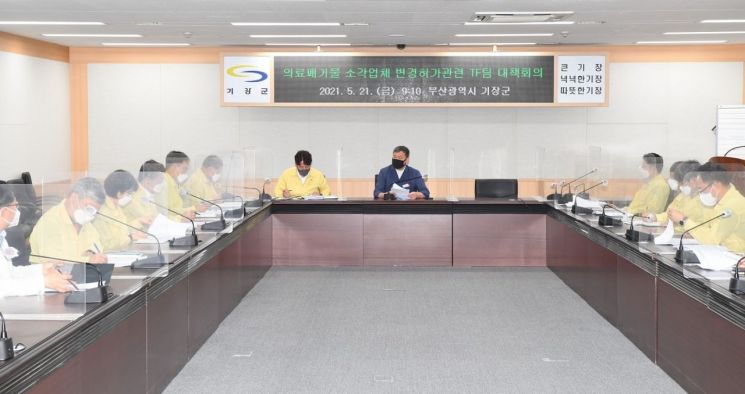 On the 21st, the TF team held a countermeasure meeting regarding the change of permit for a medical waste incineration company in Gijang-gun, Busan. [Image source=Gijang-gun]
[Asia Economy Yeongnam Reporting Headquarters Reporter Kim Yong-woo] Busan Gijang-gun sent an official letter opposing the expansion permit of the medical waste incineration plant in Jeonggwan-eup to the Nakdong River Basin Environmental Office on the 21st.
On the 22nd, Gijang-gun announced that it clearly conveyed its opposition to NC Medi, a medical waste incineration company, applying for a fivefold increase in incineration capacity.
Gijang-gun emphasized that the case of changing designated waste daily disposal capacity from less than 10 tons/day to facilities over 10 tons/day does not fall under the facilities stipulated in Article 38 of the Enforcement Rules of the Waste Management Act.
They cited significant changes in conditions and excessive capacity increase compared to the time of the report, stating that this matter should be decided as a new facility under the city and county management plan.
They also stated that the current designated waste facilities under 10 tons are located in the Water Supply Zone 1 district unit planning area, and that permits for designated waste treatment facilities over 10 tons cannot be granted without changing the existing district unit plan.
Gijang-gun conveyed to the Nakdong River Basin Environmental Office, the authority for expansion permits, that according to Article 43 (Installation and Management of Urban and County Planning Facilities) of the National Land Planning and Utilization Act, changes to the city and county management plan must precede the installation of new infrastructure.
Gijang-gun argued that the area near the facility is a densely populated area with an apartment complex (total 4,959 households, about 15,000 people) and that the incineration facility is visibly within 100 meters, causing continuous complaints from local residents.
They also stated that the area is unsuitable according to the decision criteria for waste treatment and recycling facilities stipulated in Article 157 of the Rules on the Decision, Structure, and Installation Standards of Urban and County Planning Facilities, and that even if there is a change permit or business plan approval for waste treatment, it is not allowed as the city and county management plan initiator.
Currently, an administrative lawsuit is underway regarding the designation and notification of the facility as an odor emission facility, and they plan to review and promote changes to the odor emission facility permit after the lawsuit results.
Oh Gyu-seok, Gijang-gun mayor, said, “From the beginning of the construction of Jeonggwan New Town, which accommodates 100,000 people, it was an area where medical waste treatment facilities should not be located,” and “It is absolutely unacceptable to increase the incineration capacity fivefold now.”
Mayor Oh warned, “The Nakdong River Basin Environmental Office is fully responsible for all situations including the incineration capacity expansion,” and “If they grant even a conditional permit, Gijang-gun will declare war together with the residents.”
© The Asia Business Daily(www.asiae.co.kr). All rights reserved.

















