Indication of Residential Maintenance Index System Reform
60% Total Floor Area Restriction on Aged Buildings
Difficulty in Designating Maintenance Zones Amid New Villa Proliferation
[Asia Economy Reporter Kim Hyemin] Market attention is focused on Seoul Mayor Oh Se-hoon's redevelopment deregulation measures. There is anticipation that these measures will pave the way for private redevelopment projects, which have not been newly designated even once since 2015. The key to revitalizing redevelopment is expected to be the relaxation of the aging criteria. Mayor Oh has already hinted at reforming the Residential Maintenance Index system.
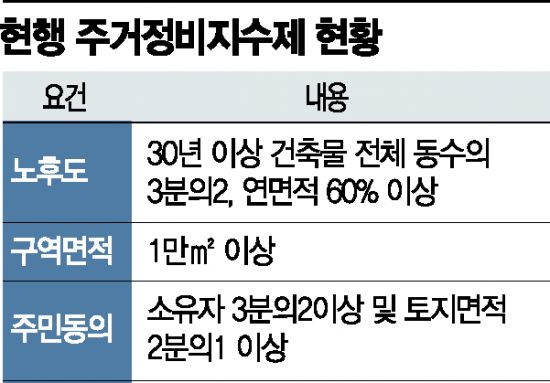
According to the maintenance industry on the 21st, market interest is rising in the 'Residential Maintenance Index system,' which Mayor Oh recently mentioned as a key target for deregulation during a press briefing. The Residential Maintenance Index system is the standard for deciding whether to designate a redevelopment maintenance zone. It was introduced in 2015 by the late former Seoul Mayor Park Won-soon. To be designated as a redevelopment maintenance zone, conditions such as housing aging and resident consent rates must be met. Specifically, buildings over 30 years old must constitute at least two-thirds of the total, and at the same time, the floor area of aged buildings must exceed 60%. Consent from at least two-thirds of owners or more than half of the land area residents is also required.
Among these, the 'floor area aging' criterion has been pointed out as the most stringent condition. This is because older residential areas often see new houses built to improve quality of life. Since former Mayor Park's inauguration in 2011, areas repeatedly removed from maintenance zones have seen active construction of new villas, making it harder to meet this ratio. Mayor Oh also diagnosed, "After 10 years since the designation was lifted, unintentionally, 3-4 story multi-family houses have been built in the lifted zones, acting as resistance factors to redevelopment. So now, it has become a situation where we cannot move forward or backward."
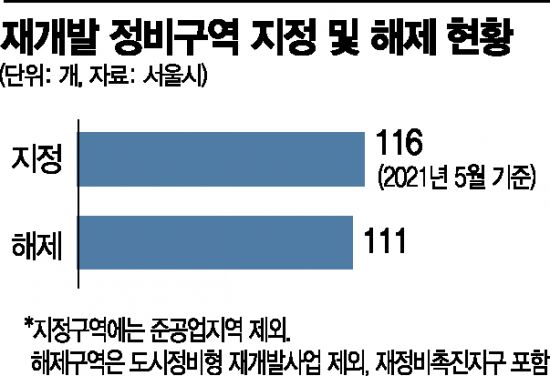
If the aging criteria within the Residential Maintenance Index system are relaxed, it is expected to breathe new life into areas where redevelopment could not be pursued due to newly built villas. This is because the possibility of re-designation for the 111 redevelopment maintenance zone lifted areas will increase.
A representative example is Seongbuk 5 District in Seongbuk-gu. This district, which was revoked from the redevelopment maintenance zone by former Mayor Park in 2011, previously applied for the first public redevelopment but was rejected for failing to meet the aging criteria. Although 84% of buildings are over 30 years old, the floor area aging ratio was only 44%. Galhyeon 2 District in Eunpyeong-gu, Daerim 3 District in Yeongdeungpo-gu, and Sungin 1 District in Jongno-gu were also rejected for public redevelopment for the same reason.
However, it is uncertain whether redevelopment can accelerate solely by relaxing the maintenance zone designation criteria. The more new villas are built, the more it affects resident consent and project feasibility. As new villas increase, density rises, and profitability can only be improved if many houses are built within the same area, which requires floor area ratio relaxation to support it. Calming opposition from new villa owners, who become cash settlement targets during redevelopment, is also a challenging task.
With the path to private redevelopment opening, there is also a possibility that public-led maintenance projects may shrink relatively. Government plans to induce public urban housing complex projects or public direct redevelopment for zones rejected from public redevelopment may face setbacks. Among the recently announced urban public housing complex project sites, such as Jeungsan 4 District in Eunpyeong-gu, many include areas where redevelopment maintenance zones were lifted.
Yoon Ji-hae, senior researcher at Real Estate 114, said, "It is a positive measure in that it broadens the market's options. Areas that are unprofitable no matter how you calculate will continue to pursue public projects, and neutral zones in terms of project feasibility or resident consent under deregulation will be compared and chosen between private or public options."
© The Asia Business Daily(www.asiae.co.kr). All rights reserved.


















