Tourism Surges Due to COVID-19, Boosting Gyeonggi Economy
Investor Interest Grows Thanks to Non-Regulated Area Advantages
Highest Sales and Jeonse Increase Since 2012
Popular Complexes Hit Record Highs... Asking Prices Soar
[Asia Economy Reporter Moon Jiwon] COVID-19 is driving up housing prices in Jeju Island. As domestic tourists flock to the area and the local economy revives, the perception that housing prices are undervalued compared to the Seoul metropolitan area, including Seoul and Gyeonggi Province, has spread, creating a buying frenzy. Popular complexes have already seen asking prices soar well beyond 1 billion KRW, and jeonse (long-term lease) prices are also rising rapidly. Real estate agents and investors in the region predict that "due to the limited supply compared to demand, the price increase trend will continue to grow."
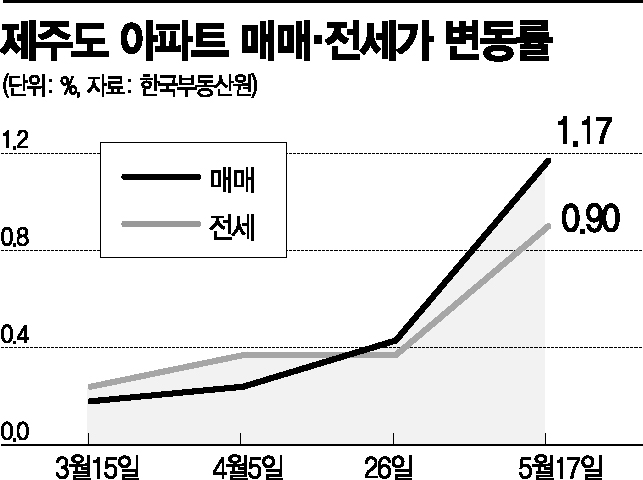
According to statistics from the Korea Real Estate Board on the 21st, apartment prices in Jeju Island rose by 1.17% this week, marking the highest increase in about nine years since the related statistics began in May 2012. It is also the first time in about five years and five months that the weekly increase rate has surpassed 1%, since the second week of December 2015 (1.01%). After a decline over three years until the end of last year due to the reduction of Chinese tourists following the 2017 THAAD (Terminal High Altitude Area Defense) deployment controversy, the market has recently entered an upward trend again.
The rapid rise in Jeju Island housing prices is interpreted as being influenced by the revitalization of tourism due to the COVID-19 pandemic and the advantage of being a non-regulated area. While the government designated most regions as regulated areas last year to curb the nationwide real estate investment frenzy, Jeju Island was excluded. As one of the few remaining non-regulated areas in the country, it is free from loan restrictions, attracting investors' attention.
A representative from real estate agency A in Nohyeong-dong, Jeju City, said, "There are many inquiries not only from actual residents but also from outsiders interested in investment," adding, "Jeju has relatively few households per complex, so it is not easy to find available properties."
In Nohyeong-dong, considered the prime apartment area in Jeju City, the Nohyeong 2nd I-Park with a 115㎡ (exclusive area) was traded at 1.05 billion KRW in December last year, and its current asking price has risen to between 1.32 billion and 1.4 billion KRW. The 84㎡ units, which were traded in the early part of last year at just over 700 million KRW, were sold for 900 million KRW in February, with asking prices around 1.05 billion KRW. A nearby real estate agent commented, "Jeju does not have many complexes with both upscale commercial districts and good school districts, so when demand surges, prices go up accordingly."
The Nohyeong E-Pyeonhansesang 125㎡ unit also set a record high last month at 970 million KRW, and Donam-dong Donam Haemoro Rich Hill 74㎡ was traded at a record high of 660 million KRW last month, with major complexes continuously hitting new highs. The E-Pyeonhansesang Yeondong Central Park 1 and 2 complexes, built on the site of the old Korean Air headquarters in Yeondong, succeeded in sales despite a high pre-sale price of around 900 million KRW for 84㎡ units.
With overseas travel blocked due to COVID-19, residential demand such as "living in Jeju Island" has increased, pushing up jeonse prices as well. According to Korea Real Estate Board statistics, Jeju Island apartment jeonse prices rose by 0.90% this week, the highest increase among all provinces nationwide. The jeonse supply-demand index recorded 119.2, also the highest level in about five years. An industry insider said, "If rental demand supports the market, sales prices will inevitably rise in the long term," adding, "Jeju Island appears to be significantly undervalued compared to other metropolitan cities, making it a highly attractive investment."
© The Asia Business Daily(www.asiae.co.kr). All rights reserved.


















