KIST Research Team: "FMD and Avian Influenza Wastewater-Contaminated Groundwater Purified"
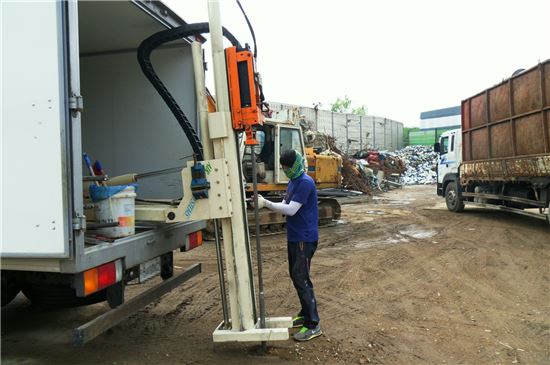 The investigation team from the Gyeonggi-do Institute of Health and Environment is examining the soil for contamination.
[Asia Economy Reporter Kim Bong-su] A technology has been developed that can purify soil contaminated by the carcasses of livestock that died from foot-and-mouth disease or avian influenza by injecting oxidizers.
The Korea Institute of Science and Technology (KIST) announced on the 20th that Dr. Jo Kyung-jin's research team at the Water Resources Circulation Research Center developed an 'In-situ chemical oxidation' (ISCO) technology that decomposes pollutants by directly injecting oxidizers such as hydrogen peroxide and persulfate into groundwater and soil at contaminated sites.
The research team exposed aquifer soil to hydrogen peroxide and persulfate respectively, then investigated microbial communities and activity, mineral composition changes, and the ability of microbial activity recovery. They confirmed that high concentrations of persulfate acidified the surrounding environmental conditions and slowed microbial activity. Overall, microbial activity decreased as the aquifer soil was exposed to oxidizers. In the case of aquifer soil exposed to low concentration (0.2mM) persulfate, the reduction in microbial activity was relatively small, but under conditions exposed to high concentration (50mM) persulfate, microbial activity significantly decreased, and mineral composition and microbial communities also changed considerably.
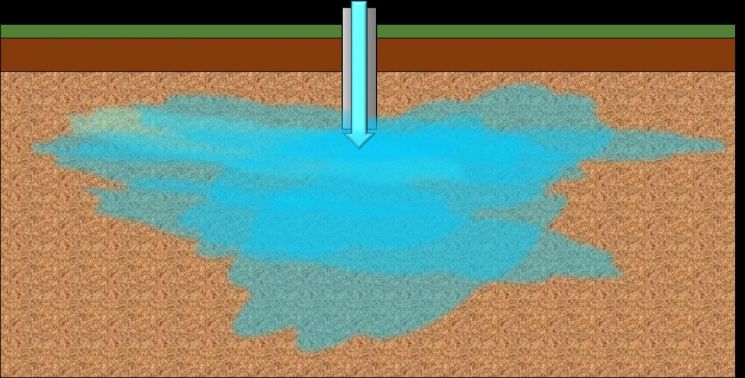
Additionally, when pollutants were injected into aquifer soil exposed to oxidizers to evaluate microbial activity recovery ability, about 60% of pollutants decomposed after six weeks in aquifer soil exposed to low concentration persulfate, which was similar to soil not exposed to oxidizers. In contrast, only 20% of organic matter decomposed in soil exposed to high concentration persulfate, confirming that self-purification ability was difficult to recover.
Dr. Jo Kyung-jin of KIST stated, “The significance lies in evaluating the stability of aquifer soil against oxidizers and proposing an environmentally friendly purification technology where microbial recovery is possible,” adding, “It is expected to contribute to securing high-quality water resources by improving groundwater quality in various contaminated areas in the future.” The results of this study were published in the latest issue of the international environmental journal Environmental Science & Technology (IF: 7.864, top 5.472% in JCR field).
© The Asia Business Daily(www.asiae.co.kr). All rights reserved.

















