[Asia Economy Reporter Suyeon Woo] Power Management Integrated Circuits (PMIC), known as the heart of electronic devices, are gaining attention as a key component driving Samsung Electronics' 'System Semiconductor 2030' strategy. The PMIC market is expected to grow at an average annual rate of 6.6% until 2024, expanding to $6.9 billion (7.8 trillion KRW), making it an essential sector within system semiconductors.
On the 18th, Samsung Electronics unveiled three new PMIC products designed to enhance the performance of next-generation DRAM modules while reducing power consumption. These new products, set to be integrated into next-generation DDR5 DRAM modules, were developed to boost DRAM performance while minimizing power usage.
PMICs are semiconductors that supply power to core chips performing key functions such as memory semiconductors. They distribute and control the power required by various parts of electronic devices, earning them the nickname "the heart of electronic devices."
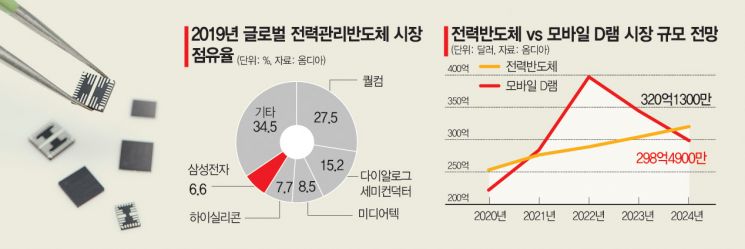
PMICs belong to the power semiconductor category, a type of system semiconductor. The power semiconductor market is projected to grow from $25.3 billion last year to $32 billion by 2024, at an average annual growth rate of about 6.1%, driven by the advancement of electronic devices and the popularization of electric vehicles. Market research firm Omdia predicts that the power semiconductor market will surpass the mobile DRAM market ($29.8 billion) by 2024 through steady growth.
Among these, Samsung Electronics is focusing on 'Power Management Integrated Circuits (PMIC),' a type of power semiconductor. In particular, the 'server DRAM PMIC' market is expected to become a key component for achieving Samsung's System Semiconductor 2030 strategy. This is because next-generation DDR5 DRAM will be applied to the server DRAM market, requiring PMICs that meet these specifications.
Samsung’s three new products standardize the direct integration of PMICs onto DRAM module substrates. By positioning the PMIC close to the DRAM instead of mounting it on an external substrate, voltage and current can be managed more stably.
Since server companies replace DRAM modules every three years, significant demand is expected, making early entry into the PMIC market compatible with DDR5 DRAM specifications very important. According to market research firm Omdia, Samsung’s PMIC market share was only 6.6% in 2019, and Samsung plans to aggressively expand its system semiconductor market share with the launch of these three PMIC products. Samsung has been supplying PMICs for SoCs, cameras, displays, and SSDs since 2010, but this is the first time it has introduced PMICs for DRAM.
Jangho Cho, Senior Vice President of the System LSI Business Division Marketing Team, said, "We applied the design technology and know-how accumulated from mobile and display PMICs to DDR5 DRAM modules used in data centers, enterprise servers, and PCs," adding, "We will continue to expand our DRAM PMIC lineup and strengthen our technological leadership."
© The Asia Business Daily(www.asiae.co.kr). All rights reserved.

















