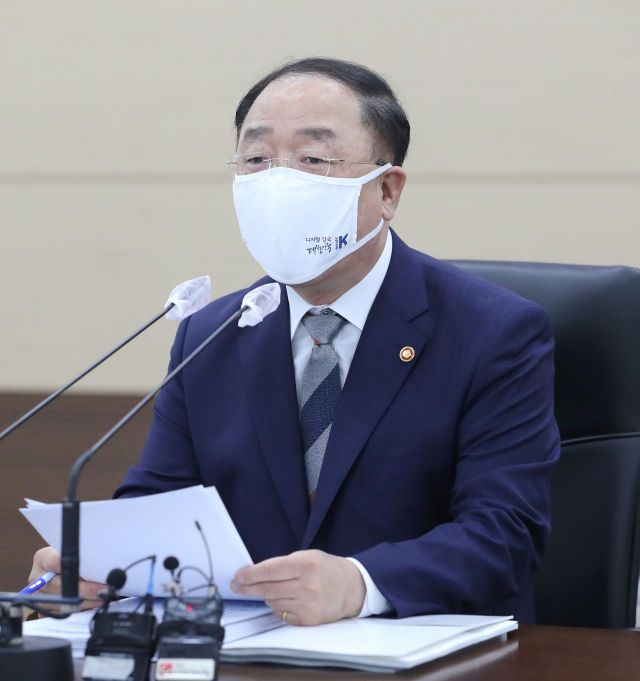
 Hong Nam-ki, Deputy Prime Minister and Minister of Economy and Finance, is speaking while presiding over the External Economic Ministers' Meeting held at the Government Complex Sejong in Sejong City on the morning of the 17th.
 [Photo by Yonhap News]
[Asia Economy Reporter Joo Sang-don] The government has officially confirmed its accession to the Digital Economy Partnership Agreement (DEPA), the first plurilateral digital agreement. It plans to begin accession negotiations with existing member countries by the end of this year. The government expects that joining DEPA will contribute to accelerating the domestic digital economic transition.
On the 17th, the government held an external economic ministers' meeting chaired by Deputy Prime Minister and Minister of Economy and Finance Hong Nam-ki to discuss the DEPA accession promotion plan, which includes these details.
At the meeting, Deputy Prime Minister Hong said, "Considering the possibility that bilateral and plurilateral digital norms may become global standards in the future and the lock-in effect of the digital industry (strengthening the dominance of market-leading companies), the necessity of joining DEPA has been raised. DEPA accession, which includes key elements such as the liberalization of data movement and utilization, facilitation of e-commerce, harmonization of differing national systems, and strengthening cooperation on new digital technologies, will contribute to accelerating the domestic digital economic transition."
DEPA is an agreement signed by Singapore, New Zealand, and Chile to strengthen cooperation in the digital economy sector. Negotiations began in May 2019 and were substantially concluded in January of the following year. It was signed in June of the same year and came into effect in January this year.
DEPA exclusively covers the digital sector. It raises the mandatory levels of existing paperless trade-related norms, mandates the provision and acceptance of electronic trade administrative documents, designs measures to support the interoperability of electronic invoices, and strives to ensure interoperability between payment systems as key norms. Additionally, it stipulates obligations to enhance international cooperation on new digital trends such as digital ID, fintech, artificial intelligence (AI) governance, data innovation, and public information openness.
The government views DEPA accession as having a broad impact on the domestic economy, including systems, technology, industry, and employment. It believes that removing and easing digital trade barriers and introducing the latest trade facilitation norms will enable the establishment of advanced domestic systems and the expansion of cross-border digital trade. Furthermore, by promoting the development and innovation of new digital technologies, it can accelerate the digital economic transition and assist domestic digital companies and models in expanding overseas. Early establishment of a regional digital cooperation network through DEPA could also maximize cooperation synergies if DEPA expands to other countries in the future.
First, the government plans to proceed smoothly with external consultations and domestic procedures aiming to start DEPA accession negotiations within this year. The specific timing for the start of accession negotiations depends on the finalization of the DEPA accession procedure guidelines, which existing member countries are expected to confirm in the first half of the year. Accordingly, the government will monitor the finalization trends of the DEPA accession procedure guidelines, continue discussions with DEPA member countries, and based on the progress of consultations, proceed with domestic procedures such as inter-ministerial consultations and gathering industry opinions.
© The Asia Business Daily(www.asiae.co.kr). All rights reserved.

















