Unlimited Usage Time and Personnel Benefits End Late July
73% of Teachers Use Zoom... "Government Support Needed"
Ministry of Education Considers Encouraging Use of School Operating Funds
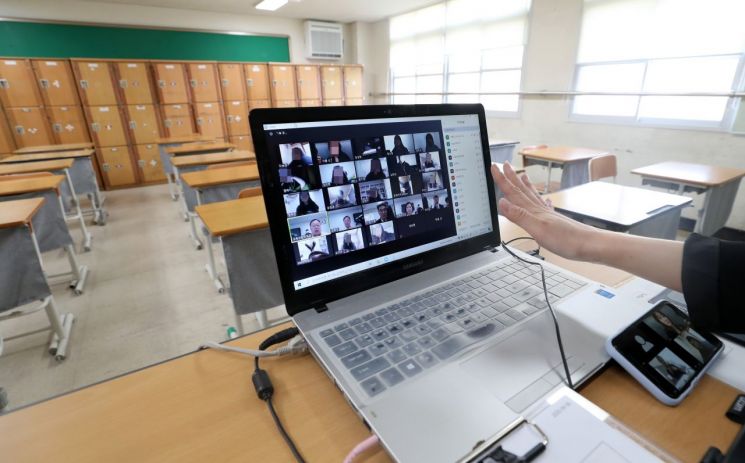
[Asia Economy Reporter Han Jinju] As the video conferencing service Zoom switches its education accounts to paid plans starting in August, signs of conflict over cost-sharing are emerging.
Zoom has provided education accounts free of charge without limits on the number of participants (up to 100) or time (40 minutes) until July 31. According to a survey conducted by the Korea Teachers and Education Workers Union (KTEU) from August 6 to 9 with 1,005 teachers, half of the teachers responded that "the education authorities should support the costs" ahead of Zoom's monetization.
On the other hand, a Ministry of Education official explained, "It is difficult to provide national funding, but expenses for software purchases can be covered from school education operation funds. We plan to discuss with metropolitan and provincial offices of education to guide school accounting officers on this matter." He added, "Switching to other services could confuse teachers, so we believe it is necessary to provide options and support accordingly."
The Seoul Metropolitan Office of Education is also encouraging the use of its self-developed remote class support platform ‘newSSEM’ or recommending the use of Naver’s video conferencing platform ‘Whale On’ rather than providing separate budget support. A Seoul Metropolitan Office of Education official said, "Until the Ministry of Education’s policy is finalized, we will gradually enable transitions to newSSEM, Whale On, e-Hakseupter, or EBS OnClass," and added, "We will also provide guidance on ways to support these within school accounting."
However, although EBS OnClass and e-Hakseupter also offer real-time interactive classes, many teachers still use Zoom due to frequent errors in those platforms. In the earlier KTEU survey, 73.0% answered that they mainly use Zoom: 79.6% in elementary schools, 61.8% in middle schools, and 61.6% in high schools. There are concerns that switching services could cause confusion, especially for lower-grade students who have been using Zoom.
An elementary school teacher pointed out, "e-Hakseupter has poor video quality, making it difficult to read students’ facial expressions, and when sharing videos, the quality drops, so the usage environment is worse than Zoom."
© The Asia Business Daily(www.asiae.co.kr). All rights reserved.
![Clutching a Stolen Dior Bag, Saying "I Hate Being Poor but Real"... The Grotesque Con of a "Human Knockoff" [Slate]](https://cwcontent.asiae.co.kr/asiaresize/183/2026021902243444107_1771435474.jpg)
















