Nuclear Phase-Out Policy Collapses Ecosystem
Mass Layoffs in Related Industries
Shift in Ruling Party Sentiment Including Representative Song Young-gil
[Sejong=Asia Economy Reporter Joo Sang-don] "Doosan Heavy Industries & Construction, which manufactures main equipment for nuclear power plants, has closed its production line after Shin-Kori Units 5 and 6. The main equipment for Shin-Hanul Units 3 and 4, whose construction was halted by Doosan Heavy Industries, is rusting. Among about 2,000 Doosan Heavy subcontractors, 800 are nuclear-related companies, and as Doosan Heavy’s orders have stopped, their jobs have disappeared as well."
On the 18th, Professor Jung Beom-jin of Kyung Hee University’s Department of Nuclear Engineering diagnosed that South Korea’s nuclear ecosystem is effectively on the brink of collapse due to the Moon Jae-in administration’s nuclear phase-out policy.
President Moon Jae-in, upon taking office in 2017, actively pursued the nuclear phase-out policy that he had proposed as a campaign pledge, declaring “zero nuclear power by 2060.” Subsequently, it was decided not to extend the lifespan of Korea’s first commercial nuclear reactor, Kori Unit 1, and to dismantle it. Furthermore, the construction of Shin-Hanul Units 3 and 4, confirmed in the 2008 4th Basic Plan for Electricity Supply and Demand, was put on hold. In the case of Cheonji Units 1 and 2, the designation of the construction site was withdrawn earlier this year. Instead, the government proposed the dismantling industry as the future growth sector for the nuclear industry.
Professor Jung stated that the decline of the nuclear industry is adversely affecting not only the nuclear sector but also various fields and personnel. He said, "If no more nuclear plants are built, companies like Doosan Heavy that produce main equipment, as well as construction companies that build nuclear plants, will struggle. Also, only 10% of the workforce involved in nuclear construction and operation are nuclear specialists; the rest are electrical, mechanical, chemical, communications, and civil engineering personnel, who will also lose their places to work."
In particular, Professor Jung noted, "For major nuclear-related components, certification must be obtained by paying fees to organizations such as the American Society of Mechanical Engineers, but Doosan Heavy has recently begun to give up these certifications. Korea Hydro & Nuclear Power is providing financial support for this, but it is difficult to prevent this trend."
Professor Jung Dong-wook of Chung-Ang University’s Department of Energy Systems Engineering said, "Energy policy should be viewed long-term, but the Moon administration declared a ‘nuclear phase-out’ without a long-term national energy vision. It is practically difficult to achieve carbon neutrality with only renewable energy, but due to the political slogan of nuclear phase-out, nuclear power is not even being discussed."
The nuclear dismantling industry, which the government has pledged to foster, is also not significantly helping the nuclear ecosystem. Professor Jung Dong-wook predicted, "Extending the lifespan of existing nuclear plants is a global trend toward a decarbonized society. Because of this, the activation of the dismantling market will inevitably be delayed." He added, "Since nuclear phase-out is a political slogan of the Moon administration, it will not be easy to abandon it, but nuclear power is necessary to realize a decarbonized society. At the very least, irreversible measures should not be taken. Just as the construction permit period for Shin-Hanul Units 3 and 4 was extended, the decision on the construction site for Cheonji Units 1 and 2 should have been deferred to the next administration."
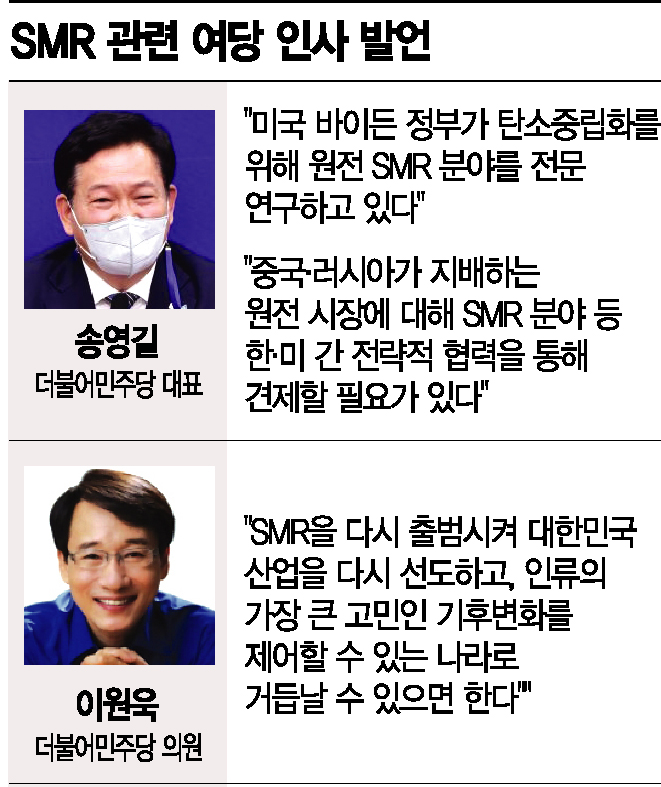
As opposition continues in various places, recent signs of change have been detected in the current government’s nuclear phase-out policy. Not only Song Young-gil, leader of the Democratic Party, but also Democratic Party lawmaker Lee Won-wook emphasized, "We need to relaunch SMR (Small Modular Reactors) so that we can become a country capable of controlling climate change, humanity’s greatest concern."
In this atmosphere, the need for large-scale nuclear power plants is also growing again. Professor Jung Beom-jin said, "The U.S. will increasingly pressure countries to reduce carbon emissions, and eventually other countries including South Korea will have no choice but to consider nuclear power. A new market could open as soon as one to two years from now. The key is whether our nuclear industry, including Doosan Heavy, can endure until then."
© The Asia Business Daily(www.asiae.co.kr). All rights reserved.

















