Temporary Shutdown at Hyundai Ulsan Plant 5 and Kia Soha Plant 2
Semiconductor Supply Shortage Expected to Continue Through Second Half of the Year
[Asia Economy Reporter Changhwan Lee] As the supply crisis of automotive semiconductors intensifies, Korea's leading automobile companies Hyundai Motor and Kia have simultaneously halted their production lines. Hyundai and Kia, along with their suppliers, are focusing on securing semiconductor supplies, but given the global supply shortage, the semiconductor shortage is likely to continue into the second half of the year.
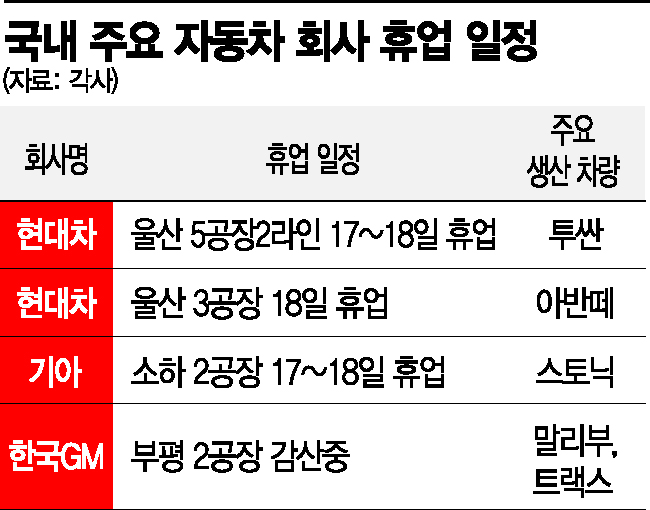
According to the automotive industry on the 17th, Hyundai and Kia temporarily suspended operations at their major plants starting that day. Hyundai plans to halt operations at Ulsan Plant 5 Line 2 for two days on the 17th and 18th, and Plant 3 will be closed for one day on the 18th.
Plant 5 Line 2 produces the popular sport utility vehicle (SUV) Tucson, while Plant 3 manufactures models such as the Avante and Venue. Kia will also suspend operations at Soha Plant 2, which produces small SUVs like the Stonic, for two days from the 17th to the 18th.
All three shutdowns are due to a shortage of automotive semiconductors. This is the first time Hyundai Motor Group has stopped two or more production lines simultaneously due to the semiconductor supply shortage. Previously, on the 6th and 7th, Hyundai halted the Porter production line at Ulsan Plant 4 due to a shortage of instrument cluster-related semiconductors. Last month, Ulsan Plant 1 was temporarily shut down from the 7th to the 14th, and Asan Plant was closed on the 12th to 13th and again from the 19th to 21st.
Korea GM is also operating Bupyeong Plant 2, which produces popular models like the Malibu and Trax, at about half capacity due to semiconductor shortages.
The industry expects the semiconductor shortage to persist throughout the second quarter and remain unresolved in the third quarter. Semiconductor demand continues to rise with consumer recovery, but semiconductor manufacturers' mass production is slow. Some predict that the semiconductor shortage could continue into next year.
Semiconductor Supply Crisis Expected to Peak in May and June
Hyundai Motor Group previously forecasted during its first-quarter earnings announcement that May and June would be the peak months of the current semiconductor supply crisis. This situation is expected to continue through next month. Besides the plants currently on temporary shutdown, other plants are reportedly discussing sequential shutdowns.
As the semiconductor supply shortage expands, the number of vehicles produced per line has also decreased, and some plants currently operating are reportedly considering so-called ‘empty conveyor’ production, where the conveyor belt runs without vehicles to assemble.
The prolonged shortage of semiconductor parts is expected to burden the profitability of automobile companies. Global consulting firm AlixPartners projected that the global finished car industry will experience a revenue loss of $110 billion (approximately 124 trillion KRW) this year due to semiconductor issues. Domestic automakers such as Hyundai, Kia, and Korea GM are also inevitably affected.
Researcher Yangjae Kim of KTB Investment & Securities said, "Although the semiconductor industry is making large-scale investments to resolve the supply shortage, it is difficult to expect rapid expansion due to issues securing new infrastructure and equipment," adding, "Recovery of automotive semiconductor supply is expected only from the fourth quarter of this year."
© The Asia Business Daily(www.asiae.co.kr). All rights reserved.

















