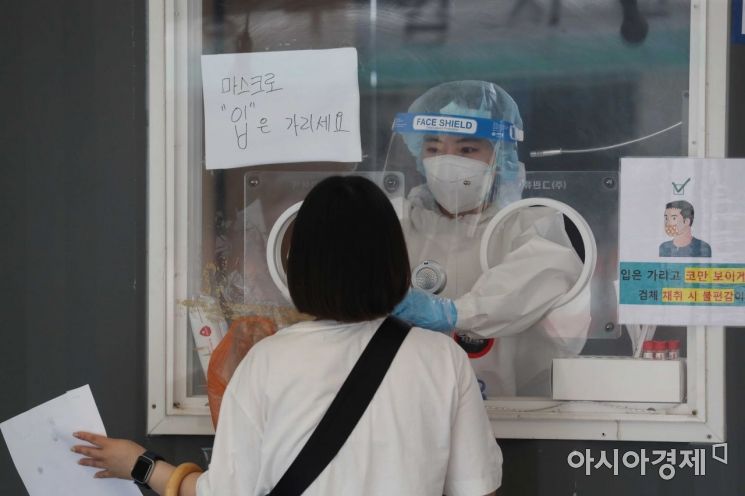
 On the 16th, citizens are undergoing specimen tests at a temporary screening clinic set up at Seoul Station Plaza. Photo by Moon Honam munonam@
[Asia Economy Reporter Lee Chun-hee] The number of new COVID-19 cases in South Korea has remained in the 600s for three consecutive days.
The Korea Disease Control and Prevention Agency's Central Disease Control Headquarters (CDCH) announced on the 17th at midnight that the total number of confirmed COVID-19 cases increased by 619 from the previous day to 132,290. The sources of infection for the new cases were 729 local transmissions and 18 imported cases.
Typically, on Mondays, due to the so-called "weekend effect," the number of tests decreases, leading to a sharp drop in confirmed cases compared to the previous Sunday. However, despite the number of tests conducted on this day being 32,843?about 14,000 fewer than the 46,815 tests on the 15th?the number of confirmed cases actually increased by 9. At temporary screening clinics set up in the metropolitan area, 13,498 tests were conducted, confirming 69 new cases, while 2,659 tests were conducted at temporary screening clinics outside the metropolitan area, confirming 9 cases.
About 60% of the 10 local transmission cases occurred in the metropolitan area. There were 192 cases (32.2%) in Seoul, 148 cases (24.8%) in Gyeonggi, and 12 cases (2.0%) in Incheon, totaling 352 cases in the metropolitan area.
Outside the metropolitan area, Gangwon Province recorded the highest number of cases at 35, influenced by a cluster infection in a military unit in Cheorwon County. Other regions reported the following: ▲Gyeongnam 30 ▲Gwangju 27 ▲Gyeongbuk 27 ▲Chungbuk 22 ▲Daegu 19 ▲Jeonnam 17 ▲Ulsan 16 ▲Jeju 15 ▲Chungnam 14 ▲Busan 12 ▲Incheon 12 ▲Jeonbuk 9 ▲Daejeon 2. There were no new cases in Sejong.
The weekly average of daily local transmission cases, a key indicator for adjusting social distancing levels, is rapidly increasing again. The weekly average, which had been maintained in the mid-500s for some time, surpassed 600 again at 621 as of this day, marking the first time in 13 days since the 4th.
There were 22 imported cases. Among them, 9 were detected during quarantine, and 13 were confirmed locally. Fifteen were Korean nationals, and 7 were foreigners.
The number of patients who have recovered and been released from isolation reached 122,163, an increase of 399 from the previous day. Among the confirmed patients receiving inpatient treatment, 151 are in severe or critical condition. The death toll rose by 3 to 1,903.
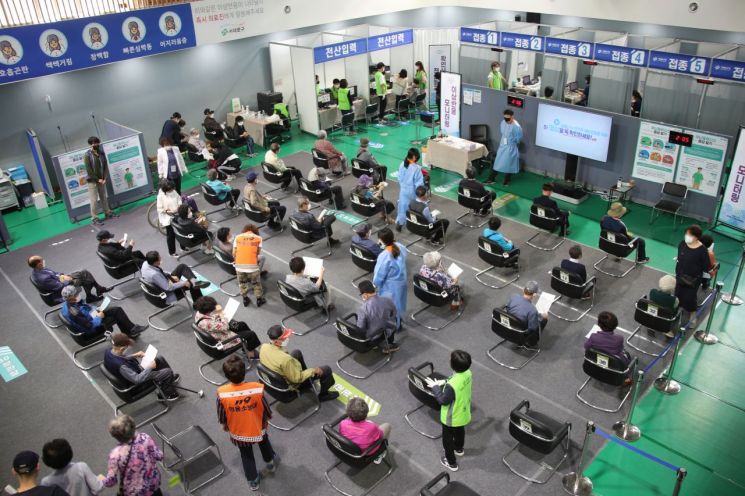 On the afternoon of the 14th, citizens who completed their vaccinations at the vaccination center in Seodaemun-gu, Seoul, are sitting and waiting in the observation area. [Image source=Yonhap News]
Meanwhile, as of midnight on this day, 5 people received their first dose of the COVID-19 vaccine. All of them were vaccinated with the Pfizer vaccine. This brings the total number of people who have completed the first dose to 3,733,806. Among them, 2,045,778 received the AstraZeneca (AZ) vaccine, and 1,688,028 received the Pfizer vaccine. The vaccination rate relative to the population is 7.3%.
The number of people who completed the second dose increased by 4,986 from the previous day to 940,345. They also all received the Pfizer vaccine. The second dose vaccination rate relative to the population is 1.8%. By vaccine type, the number of people who completed the second dose is 6,043 for AZ and 934,302 for Pfizer.
Reports of suspected adverse reactions increased by 77 cases over two days since the 15th, totaling 22,199 cases.
One additional death was reported after vaccination. The deceased had received the Pfizer vaccine. This brings the total number of deaths after Pfizer vaccination to 65, and the total number of deaths after COVID-19 vaccination to 123.
There were no reports of suspected anaphylaxis cases, and three major adverse reaction cases involving special interest, intensive care unit admission, or life-threatening conditions were reported.
The remaining 73 cases involved common adverse reactions after vaccination such as muscle pain, headache, fever, chills, and nausea.
© The Asia Business Daily(www.asiae.co.kr). All rights reserved.


















