Electric Vehicle with Maximum Rated Output 15kW, Engine Displacement 250cc, Speed Under 80km/h
Released in 2017, Over 7,000 Units Sold in 5 Years "Market Expanding"
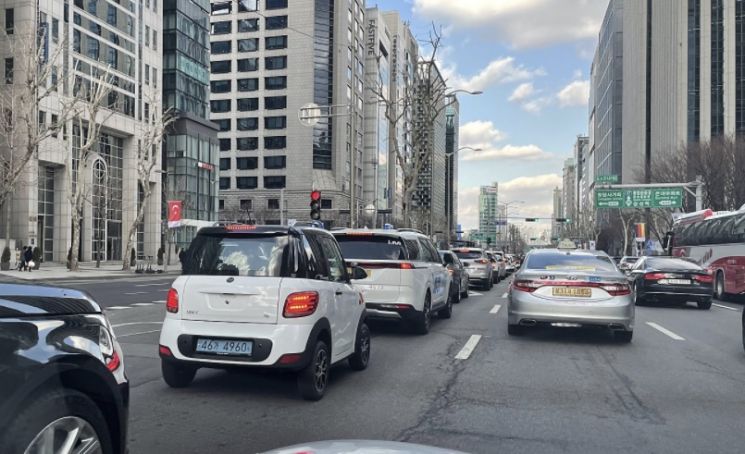 Micro electric vehicle Maibe (white car with blue license plate on the left) operating in the city center.
 [Photo by KST Electric]
[Asia Economy Reporter Kim Jong-hwa] As urban logistics such as delivery increase, ultra-small electric vehicles are gaining popularity. With advantages such as subsidies from local governments, various tax exemptions for operating eco-friendly vehicles, and low maintenance costs, the number of buyers is also increasing.
The Ministry of Land, Infrastructure and Transport's Automobile Management Act specifies ultra-small electric vehicles as electric cars with a maximum rated output of 15 kW or less, engine displacement of 250cc or less, weight of 600 kg (passenger) or 750 kg (commercial) or less, speed of 80 km/h or less, and dimensions of length 3600 mm, width 1500 mm, and height 2000 mm or less, capable of carrying 1 to 2 people.
In Korea, manufacturers of ultra-small electric vehicles include 9 companies: Sebo Mobility (Camsys), Semisysco, Master Electric Vehicle, Daechang Motors, Renault Samsung, KST Electric, DP Co., SNK Motors, and Woosoo TMM.
According to the Korea Smart e-Mobility Association (KEMA), the number of ultra-small electric vehicles sold through 7 member companies affiliated with the association totaled 6,959 units: 768 units in 2017, 1,917 units in 2018, 2,275 units in 2019, and 1,999 units in 2020. When adding sales from 2 companies not members of the association, it is estimated to exceed 7,000 units significantly.
Last year, sales declined as the Korea Post delayed additional purchases of ultra-small electric vehicles due to the impact of COVID-19, but this year the upward trend has been strong from the start. The company gaining the most momentum is KST Electric, which produces the "Myve." In December last year, Myve supplied 15 units to Korea Yakult, and last month, 2 units to Mesh Korea, which operates the logistics brand VROONG, and they are currently running through downtown Gangnam, Seoul.
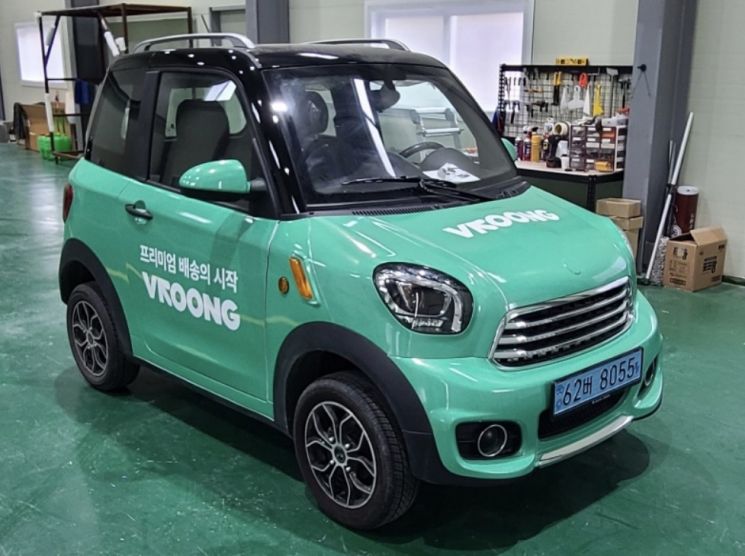 MyV, a micro electric vehicle from the logistics brand 'Vroong' operating in Gangnam.
 [Photo by KST Electric].
KST Electric has sold about 100 units since the Myve launch in October last year, and following the new model release at the end of last month, 300 customers have already made pre-orders, showing its popularity. A KST Electric official said, "Last-mile companies purchase for delivery, public institutions and corporations for business use, and individuals as a second car for short distances," adding, "We aim to sell 1,000 units this year."
Renault Samsung's "Twizy" and Sebo Mobility's "Sebo" are also popular models. Twizy sold 96 units last month alone, and Sebo Mobility's "Sebo" has attracted consumer interest since starting a special sale this month. DP Co.'s "Portro" has been sold as delivery vehicles to Lotte Super and the National Agricultural Cooperative Federation. Master Automobile's "Master Van," Daechang Motors' "Danigo 3," and Semisysco's "DC2," which were selected as suppliers to the Korea Post last year, are actively marketing to small marts and small business owners while aiming to re-enter the Korea Post this year.
The popularity of ultra-small electric vehicles is due to their affordable price. The 2021 Myve M1's launch price is 17.49 million KRW. With subsidies from local governments such as 6 million KRW from Seoul and 9 million KRW from Gwangmyeong, and exemptions from various taxes including individual consumption tax, the purchase price can be around 7 to 8 million KRW. Moreover, monthly maintenance costs are only about 40,000 KRW for electricity. It fully charges in 3 hours with a 220V outlet once a day and can travel 100 km on a single charge.
Therefore, many public institutions, local governments, and companies purchase them for business use, and neighborhood marts and small business owners prefer ultra-small electric vehicles that can carry more than two-wheelers and are safer.
However, a downside is that they cannot operate on motorways because they travel at speeds below 80 km/h. Regarding this, a Smart e-Mobility Association official said, "Since traffic laws require most arterial roads in urban areas to have speed limits of 50 km/h or less, this regulation is practically ineffective," adding, "We are requesting the government to improve the regulations."
An industry insider said, "The domestic ultra-small electric vehicle market is worth 120 billion KRW and is not large yet but is gradually expanding," adding, "Ultra-small electric vehicles are increasingly sought after because they are safer and warmer than two-wheelers when it rains or is cold."
© The Asia Business Daily(www.asiae.co.kr). All rights reserved.
![Clutching a Stolen Dior Bag, Saying "I Hate Being Poor but Real"... The Grotesque Con of a "Human Knockoff" [Slate]](https://cwcontent.asiae.co.kr/asiaresize/183/2026021902243444107_1771435474.jpg)

















