[Asia Economy Reporter Baek Kyunghwan] A ruling has been made that filming a person who is threatening in order to collect evidence cannot be considered an infringement of portrait rights. It was also deemed not to violate social norms as it was for the purpose of preserving evidence for criminal proceedings.
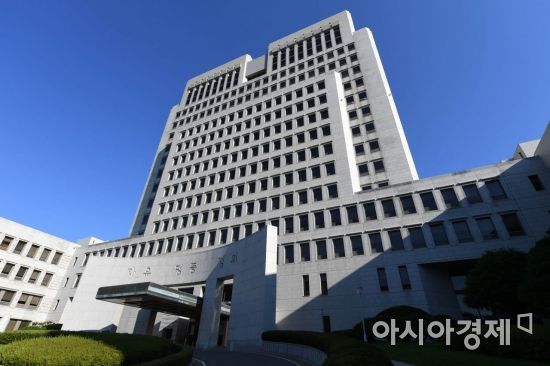
The Supreme Court recently upheld the lower court's ruling in the appeal case of Mr. A, a resident of an apartment in Jeonju, Jeollabuk-do, who filed a lawsuit claiming damages against Ms. B, the head of the women's association, and three other residents, confirming the plaintiff's loss.
In February 2018, Mr. A attempted to post a banner without permission within the apartment complex. When a resident who witnessed this tried to stop him, Mr. A verbally abused them. Resident Ms. B, who was present during this incident, recorded the event on her mobile phone and sent the video to the apartment manager and 14 representatives through another resident.
Later in April, when Ms. B visited Mr. A to complain about noise between floors, Mr. A cursed and twisted Ms. B’s arm. He was eventually prosecuted for assault and received a summary order with a fine of 500,000 won. During the assault, Ms. B also recorded Mr. A’s actions on her mobile phone.
The issue arose here. Mr. A filed a lawsuit claiming that Ms. B’s filming of him in February and April violated his portrait rights and demanded 5 million won in damages from Ms. B and the residents.
However, the judgments in the first and second trials found that the filming was not illegal. The first trial dismissed Mr. A’s claim, and the second trial upheld the dismissal of his appeal. In particular, the second trial court pointed out, "The defendant needed to film to collect and preserve evidence related to criminal proceedings because there was a dispute and emotions were running high, and there was a possibility that the plaintiff would use abusive language or violence. It was necessary to collect materials regarding the circumstances before and after the incident." The court recognized the necessity and urgency of preserving evidence for criminal proceedings and the appropriateness of the method, concluding that the filming did not violate social norms.
It further stated, "The banner posting was Mr. A’s way of expressing his claims and opinions," and "This can be implicitly considered as consent to photography or publication." It also ruled that "the video was transmitted in a limited manner and falls within the scope that Mr. A must accept," dismissing all of his claims.
The Supreme Court’s decision was no different. The bench stated, "The lower court did not err in its legal interpretation regarding the justifications for the illegality of the portrait rights infringement and did not make a mistake that affected the judgment."
© The Asia Business Daily(www.asiae.co.kr). All rights reserved.
![Clutching a Stolen Dior Bag, Saying "I Hate Being Poor but Real"... The Grotesque Con of a "Human Knockoff" [Slate]](https://cwcontent.asiae.co.kr/asiaresize/183/2026021902243444107_1771435474.jpg)
















