Minimum Wage Opinion Survey for Self-Employed
54% of Self-Employed Say "No Capacity to Hire Even if Minimum Wage is Frozen"
[Asia Economy Reporter Kim Heung-soon] A survey revealed that more than half of self-employed individuals currently view the minimum wage as "a significant burden on management." More than half of respondents also expressed difficulties, stating they currently lack the capacity to hire, arguing that excessive minimum wage increases should be restrained.
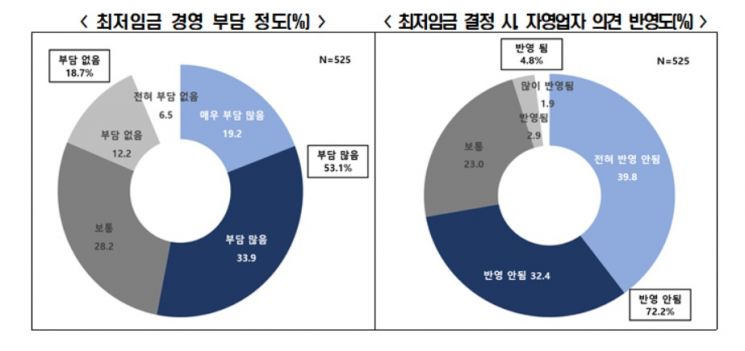
According to the results announced on the 16th by the Korea Economic Research Institute (KERI) under the Federation of Korean Industries, which commissioned the polling agency Mono Research to conduct a 'Survey on the Minimum Wage' targeting 525 self-employed individuals nationwide, more than half (53.1%) of the self-employed responded that the current minimum wage (8,720 KRW per hour) is a considerable burden on their business operations. Additionally, 72.2% of self-employed respondents pointed out that their opinions are not reflected in the minimum wage decision-making process.
KERI stated regarding these results, "Given the prolonged impact of COVID-19 and the ongoing unrecovered damages to self-employed and small business owners, there is a greater need than ever for careful consideration in determining the minimum wage."
More Than Half of Self-Employed "Currently No Capacity to Hire"
32.2% Say "Already at Management Limit"
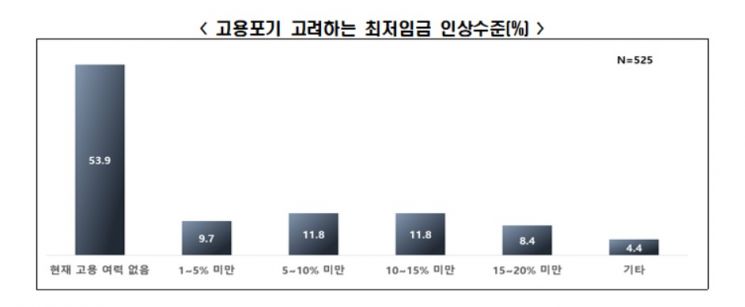
When asked how much of a minimum wage increase would lead them to forgo hiring new employees or consider laying off existing staff, 53.9% of self-employed individuals answered, "I currently have no capacity to hire." Following that, 11.8% said they would consider giving up new hires or laying off existing employees if the minimum wage increased by 5-10% or 10-15%, respectively.
Regarding how much of a minimum wage increase would make them consider closing their business, the most common response was "Already at the limit" at 32.2%. Notably, 40.6% of self-employed individuals without employees or those with family members working responded that they are "already at the limit to consider closure," indicating that even "solo entrepreneurs" are in a precarious position.
KERI analyzed, "Excessive increases in the minimum wage cause widespread price inflation, so even self-employed individuals without employees inevitably suffer damage."
23.6% Currently Considering Price Increases
27.2% Would Consider Price Increases if Minimum Wage Rises Less Than 1-5%
It was found that 23.6% of self-employed individuals are already considering raising their selling prices. The highest response rate (27.2%) was for considering price increases if the minimum wage rises by less than 1-5%.
Looking at the responses by industry for those currently planning price increases or considering price increases if the minimum wage rises less than 5%, wholesale and retail trade (55.6%) and accommodation and food services (53.2%) showed the highest rates.
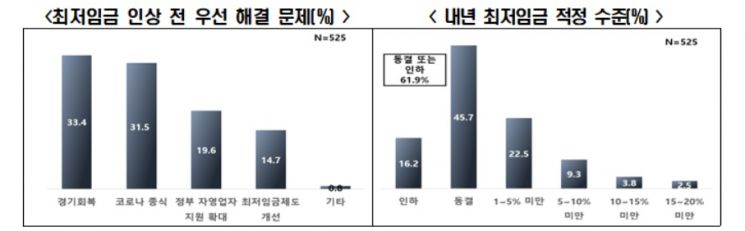
Among those who believe the minimum wage should be increased, the most common answer was that economic recovery (33.4%) should come first. This was followed by the end of COVID-19 (31.5%), expanded government support for self-employed individuals (19.6%), and improvements to the minimum wage system (14.7%).
"Economic Recovery Should Take Priority Over Minimum Wage Increase"
61.9% Say "Freeze or Reduce Next Year"
Regarding the appropriate level of the minimum wage for next year, freezing it was the most popular response at 45.7%, and combined with those who said it should be reduced, the total reached 61.9%. Particularly, the need to freeze or reduce the minimum wage was higher in the accommodation and food services sector (69.8%) and wholesale and retail trade (63.8%). Additionally, 60.3% of solo entrepreneurs, who are not directly affected by minimum wage increases, also responded that freezing or reducing the wage is necessary.
The most urgent improvement task related to the current minimum wage system was "realizing the basis for minimum wage calculation (excluding statutory weekly holiday hours from the denominator when calculating hourly wages)" as the top priority, followed by "differentiated application by region and industry" as the second priority.
Choo Kwang-ho, Director of Economic Policy at KERI, stated, "Due to the sharp increase in the minimum wage, employment has been decreasing since the end of 2018, and with the prolonged COVID-19 pandemic, many self-employed individuals find it increasingly difficult to endure. To ensure the survival of micro and small business owners, excessive minimum wage increases should be restrained."
© The Asia Business Daily(www.asiae.co.kr). All rights reserved.



















