Experimental Results Using Mice Reveal Effectiveness of Blocking Brain Appetite-Suppressing Substance Transmission
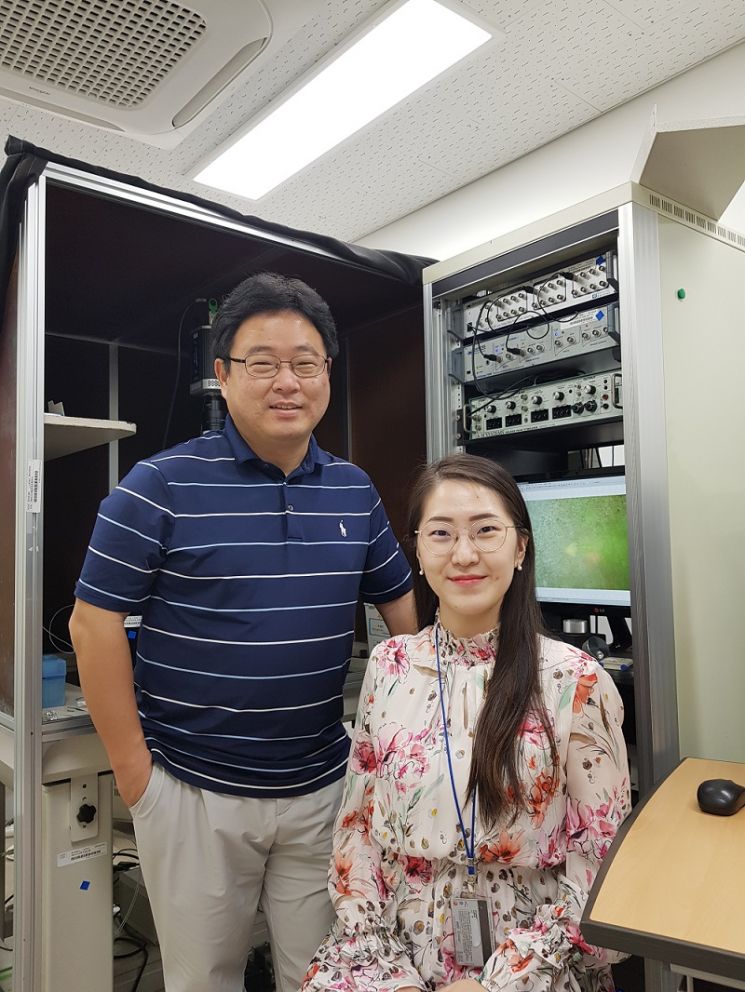 Professor Jongwoo Son (left) of the Department of Biological Sciences at KAIST, and Eunsun Yoo, integrated master's and doctoral program student.
[Asia Economy Reporter Kim Bong-su] The cause of obesity, a side effect of schizophrenia treatment drugs, has been identified, which is expected to help in prevention.
The research team led by Professor Son Jong-woo of the Department of Biological Sciences at the Korea Advanced Institute of Science and Technology (KAIST) announced on the 17th that they succeeded in identifying the cause of obesity caused by atypical antipsychotic drugs. Atypical antipsychotic drugs are used to treat schizophrenia by binding to dopamine and serotonin receptors in the central nervous system, thereby blocking the action of brain neurotransmitters.
The research results were published online on the 12th (local time) in volume 218, issue 7 of the international journal Journal of Experimental Medicine.
According to KAIST, atypical antipsychotic drugs such as 'Risperidone' and 'Olanzapine' are widely used to treat various neuropsychiatric disorders including schizophrenia, bipolar disorder, and autism spectrum disorder. Compared to typical antipsychotic drugs, atypical antipsychotics have fewer motor side effects but cause excessive appetite and obesity. However, previous animal experiments failed to reproduce the obesity observed in patients, limiting the understanding of the cause of obesity induced by atypical antipsychotic drugs.
The research team included Risperidone in the feed given to mice and confirmed increased food intake and obesity. In particular, they discovered that Risperidone reduces the responsiveness to melanocortin, one of the important neurotransmitters that suppress appetite in the hypothalamus, the brain region that regulates the body's homeostasis.
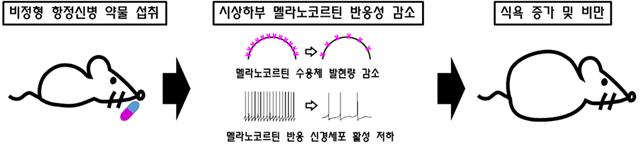
The team also confirmed that administering Setmelanotide, an appetite suppressant that increases the activity of melanocortin-responsive neurons, along with Risperidone to mice can prevent obesity while preserving the antipsychotic effects of Risperidone. Setmelanotide (brand name: Imcivree) was approved by the U.S. FDA in November last year and is currently used to treat obesity caused by certain genetic factors.
Professor Son Jong-woo stated, "This is the first time the cause of increased appetite and obesity induced by atypical antipsychotic drugs has been identified at the neuronal and molecular levels, which is expected to aid in the treatment of neuropsychiatric disorders using these drugs in the future." He added, "Although we confirmed that Risperidone reduces hypothalamic melanocortin responsiveness, it is not yet known whether this phenomenon applies to other atypical antipsychotic drugs, so we plan to focus research on this area."
© The Asia Business Daily(www.asiae.co.kr). All rights reserved.


















