"Meaning of Becoming an Opposition Leader in Gwangju Without Temporal or Moral Responsibility"
"Dogmatic Execution of Appointing Female Ministers Is a Problem"
[Asia Economy Reporters Naju-seok and Park Joon-yi] "If I am elected as the leader of the People Power Party, it will be the first time that a generation that did not experience the May 18 Gwangju Democratization Movement becomes party leader. This will have an effect beyond merely apologizing to Honam."
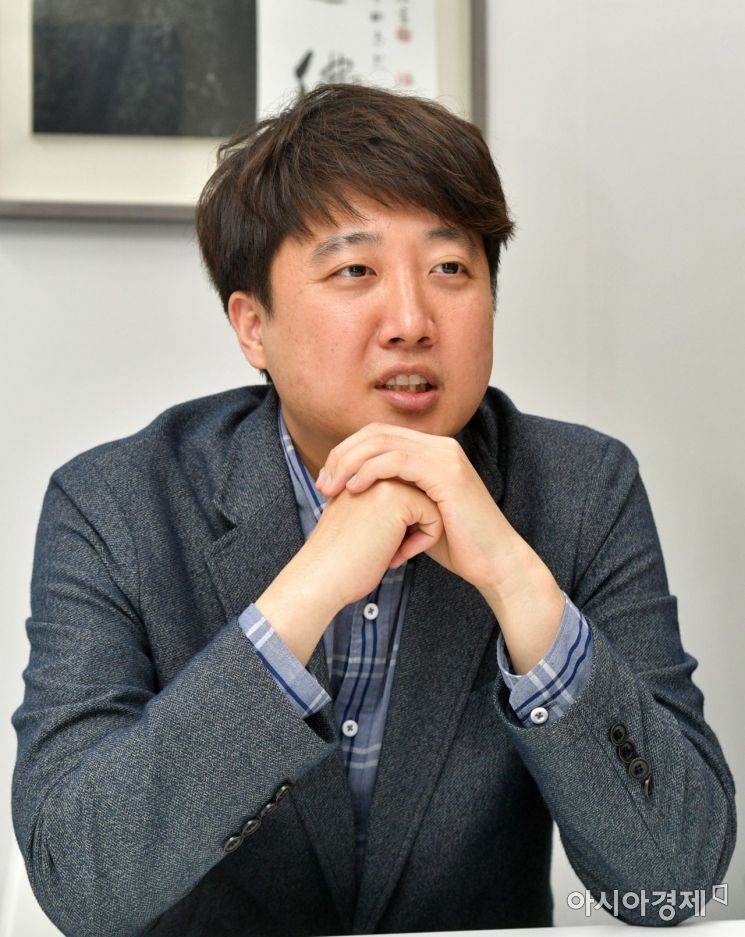
Lee Jun-seok, former Supreme Council member who has thrown his hat into the ring for the People Power Party leadership race, told Asia Economy in an interview, "If someone born in 1985 becomes party leader, the 1980 Gwangju Democratization Uprising will no longer be a source of internal conflict within the party." Lee explained, "I have no hesitation in talking about the Gwangju Democratization Movement and have been paying respects since the Bareunmirae Party days."
Lee expressed his intention to 'succeed' the Honam-related policies pursued by former People Power Party emergency committee chairman Kim Jong-in, stating, "If the People Power Party leadership is headed by someone who does not bear any temporal or moral responsibility for the Gwangju Democratization Movement, that would be a different issue." He added, "In the case of the United States, the Democratic Party was once a party that supported slavery, but now it represents minorities; time resolves such issues," and said, "(My election) could be a turning point."
Lee also shared his stance on the recently controversial gender issues. He said, "Labeling me as misogynistic just because I said a few words is a stereotypical assumption," and added, "Calling for the abolition of quotas misogyny is an attempt to make this discussion taboo, which I strongly oppose."
Lee introduced that "When I came as an emergency committee member during Park Geun-hye’s leadership in 2012, I suggested that instead of a 5:5 gender ratio for proportional representation, if there are capable women, it could be 7:3." He then referred to the process where former People Power Party lawmaker Na Kyung-won, who defeated former Justice Party lawmaker Roh Hoe-chan in Dongjak District, and Justice Party lawmakers Ryu Ho-jeong and Jang Hye-jung were elected as youth proportional representatives rather than female representatives, saying, "Rather, if quotas are abolished and elections are held, women can be represented according to the gender ratio."
He said, "If it is a male-dominated society, it should be corrected, but I have not felt that," and added, "If there is discrimination in employment, it should be regulated by law, and if it still exists, it is a crime."
Lee also strongly criticized the current government’s women’s policies. He said, "Our party also aimed to increase the proportion of female ministers," and pointed out, "It is not bad to appoint female ministers, but the problem lies in carrying it out dogmatically." He stated, "It is fine to have internal principles about how many female ministers to appoint, but publicly declaring this and causing social conflict is not right."
© The Asia Business Daily(www.asiae.co.kr). All rights reserved.

















