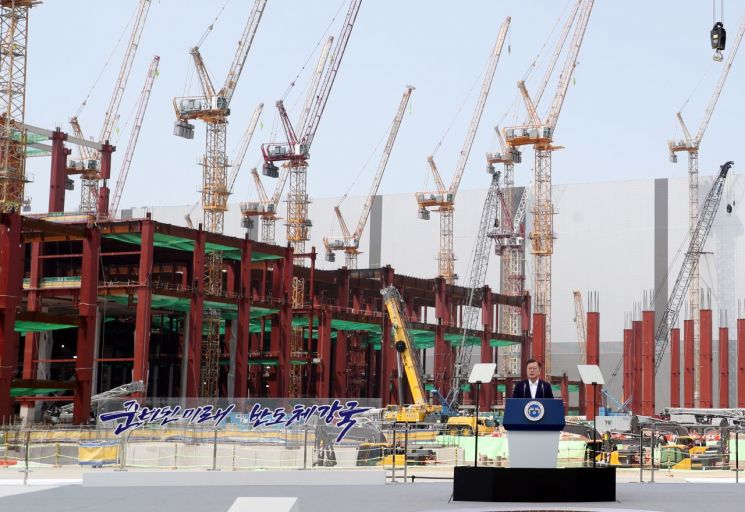
[Sejong=Asia Economy Reporters Haeyoung Kwon, Sangdon Joo, Hyunjin Jung] The government's newly announced 'K-Semiconductor Strategy' is significant in that it includes comprehensive support measures such as tax incentives, infrastructure, and workforce development to back private investments worth 510 trillion won over the next decade. However, since semiconductors are capital-intensive industries where large-scale production facility investments determine competitiveness and are also knowledge-accumulating industries, there are calls for the government to continuously play an active role. Experts urge expanding tax benefits for large corporations' facility investments and establishing concrete workforce development plans, emphasizing the need to enact a 'Semiconductor Special Act' containing more detailed action plans as soon as possible.
Semiconductor industry insiders and experts mostly gave favorable evaluations of the government's K-Semiconductor Strategy announced on the 13th. The policy includes support measures such as securing semiconductor water supply volumes for 10 years in areas like Yongin and Pyeongtaek, and up to 50% government support for power infrastructure construction in semiconductor manufacturing complexes. Samsung Electronics, SK Hynix, and others have faced difficulties securing water and power due to various regulations and opposition from local governments whenever building semiconductor plants.
Juwan Lee, Research Fellow at POSCO Research Institute, evaluated, "The government formulated the policy based on a sufficient understanding that even with money, semiconductor factories cannot be built without infrastructure like electricity and water."
However, there are criticisms that the industry's demands regarding tax credits for large corporations' facility investments were not fully reflected.
The government has newly established a 'Core Strategic Technology' track within corporate tax credits, expanding the deduction limits to up to 40-50% for research and development (R&D) investments and up to 10-20% for facility investments. The tax credit limit for large corporations' facility investments was raised from the previous 3% to 6-10%. However, this falls far short of the industry's initial demand of '50%.'
Jaegun Park, President of the Korea Semiconductor Display Technology Society and Professor at Hanyang University, said, "Expanding tax credits for large corporations' production facilities is positive, but the credit rate should be increased during the enactment process of the Semiconductor Special Act." He added, "Before selecting which technologies to include in the semiconductor core strategic technology category eligible for additional tax credits, expert groups such as academia should conduct a thorough review."
The government must select technologies to include in the core strategic technology track. It is explained that various strategic technologies, including electronic control unit (ECU) systems used in future autonomous electric vehicles, should be incorporated to ensure these translate into practical tax benefits.
Regarding the plan to nurture 36,000 semiconductor industry personnel over the next decade, it is pointed out that the plan should include not only practical implementation measures but also strategies for training high-level personnel at the master's and doctoral levels. Research Fellow Lee said, "Specific details on how to cultivate semiconductor personnel within national and public universities, departments, and quotas are missing," adding, "Since semiconductors require more design personnel than process personnel, the plan should also address how to train them."
Jongho Lee, Director of the Semiconductor Joint Research Center at Seoul National University, advised, "Semiconductors are a knowledge-accumulating field, and the workforce trained at the undergraduate level covers relatively low technical levels. We need to create master's and doctoral programs to support outstanding talents at the national level and entrust them with leading technology development to open new markets."
Experts also emphasized the necessity of a Semiconductor Special Act alongside the government's policies. President Park stressed, "Continuous support through legislation is essential for this policy to be effective," adding, "Since the US, Europe, and Taiwan are moving quickly, the bill should be proposed and pushed for enactment before August."
© The Asia Business Daily(www.asiae.co.kr). All rights reserved.
![Clutching a Stolen Dior Bag, Saying "I Hate Being Poor but Real"... The Grotesque Con of a "Human Knockoff" [Slate]](https://cwcontent.asiae.co.kr/asiaresize/183/2026021902243444107_1771435474.jpg)
















