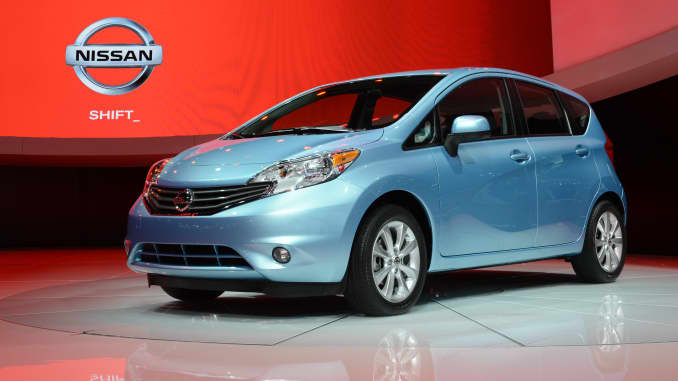
[Asia Economy Reporter Yujin Cho] As the semiconductor shortage intensifies, Japan's Nissan Motor has announced that the scale of vehicle production disruptions due to the semiconductor supply shortage this year will reach 500,000 units.
On the 13th (local time), Makoto Uchida, Nissan's Chief Executive Officer (CEO), stated in an interview with the US economic media CNBC's "Squawk Box Europe," "We are facing difficulties due to semiconductor shortages and soaring raw material prices."
He added, "The currently expected production disruption this year is about 500,000 units," and "We will take measures to normalize production."
The expected production disruption announced by Nissan this year accounts for about 12.5% of last year's total sales volume (4 million units). Nissan predicts that this year's total sales volume will reach 4.4 million units, an increase of about 10% compared to the previous year.
Due to the global sales slump caused by the COVID-19 pandemic, Nissan recorded an operating loss of approximately 151 billion yen in the 2020 fiscal year. The company expects to continue a similar level of deficit this year as well.
In the recent earnings conference, Nissan expressed concerns that although automobile demand in the US and China is recovering rapidly, the semiconductor supply shortage and rising raw material prices are hindering profitability.
Earlier, major US automakers such as Ford, Volkswagen, and Stellantis also warned that production disruptions would continue this year due to the semiconductor crisis.
The impact of the semiconductor supply shortage is spreading even to European luxury car brands. CNBC reported that the UK’s Jaguar Land Rover decided to temporarily halt production lines at its Castle Bromwich and Halewood plants in the UK.
This announcement came two months after the company declared plans to cut about 2,000 jobs in non-production sectors. Daimler in Germany, which produces Mercedes-Benz, has also implemented reduced working hours for 18,500 employees.
CNBC cited market analysts' forecasts predicting that the global semiconductor supply shortage will continue beyond next year and into the following year.
© The Asia Business Daily(www.asiae.co.kr). All rights reserved.

















