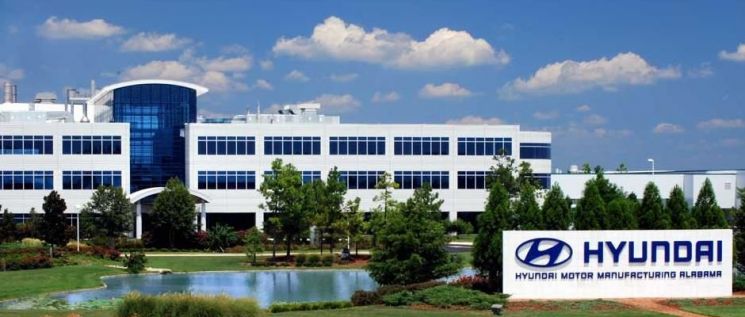
[Asia Economy Reporter Changhwan Lee] Hyundai Motor Group has decided to make an investment worth 8 trillion won, including producing electric vehicles in the United States. This move is interpreted as Hyundai's active response by expanding local investments in line with the U.S. government's recent strong promotion of the Green New Deal and Buy America strategies.
On the 14th, Hyundai Motor Group announced that it will invest a total of $7.4 billion (approximately 8.1417 trillion won) in the U.S. to produce electric vehicles, expand production facilities, and secure future growth engines such as hydrogen, Urban Air Mobility (UAM), robotics, and autonomous driving.
Both Hyundai Motor and Kia plan to locally produce electric vehicle models in the U.S. In particular, Hyundai Motor will start its first production next year. They plan to establish a phased production expansion plan, including facility expansion, by reviewing local market conditions and U.S. eco-friendly vehicle policies. Industry insiders expect that the Ioniq 5 will be produced first, followed by other electric vehicle models sequentially produced locally.
Hyundai Motor's push for local production of electric vehicle models is due to the expected rapid increase in demand for electric vehicles in the U.S. The industry forecasts that the U.S. electric vehicle market will expand significantly to 2.4 million units in 2025, 4.8 million units in 2030, and 8 million units in 2035.
It is also interpreted as a proactive response to the Biden administration's strong promotion of the 'Green New Deal' and 'Buy America' strategies and related electric vehicle policies.
Earlier this year, U.S. President Joe Biden signed the 'Buy American' executive order immediately after taking office. This requires U.S. government agencies to obtain approval from the Office of Management and Budget (OMB) when purchasing foreign products or services, focusing government procurement worth $600 billion (approximately 661 trillion won) annually on domestic companies. Additionally, all 440,000 government fleet vehicles will be replaced with American-made electric vehicles.
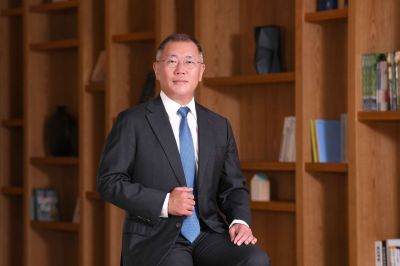
Accordingly, Hyundai Motor Group Chairman Chung Euisun is interpreted to have made a decisive decision to expand investment in the U.S. Earlier, at the end of last month, Chairman Chung visited Los Angeles (LA) for a week, touring Hyundai Motor's U.S. sales corporation and the Alabama Hyundai plant. At that time, the industry noted his sudden U.S. trip ahead of the Korea-U.S. summit and anticipated the possibility of expanding investment in the U.S., including local electric vehicle production.
A Hyundai Motor Group official stated, "Through investment for electric vehicle production in the U.S., we plan to establish a system capable of stable electric vehicle supply to secure firm electrification leadership. This is to respond to new electric vehicle demand in the U.S., and there will be no transfer of domestic electric vehicle production volume; domestic plants will continue to serve as key bases for electric vehicles."
Expansion of Hydrogen, UAM, and Robotics Investments in the U.S.
Hyundai Motor Group also explained that it plans to actively cooperate with the U.S. government and companies to expand the hydrogen ecosystem in the U.S.
They will continue collaboration with the U.S. Department of Energy (DOE) for hydrogen and hydrogen fuel cell technology innovation and global expansion, and promote demonstration of hydrogen charging infrastructure with local companies, logistics transportation using hydrogen fuel cell trucks linked to ports, pilot projects for commercialization of hydrogen fuel cell trucks, and supply of fuel cell systems.
They will also pursue demonstration projects for hydrogen charging infrastructure based on hydrogen fuel cell trucks with U.S. hydrogen charging specialists. Pilot logistics projects using hydrogen fuel cell trucks between ports and inland logistics bases will be conducted. Furthermore, pilot commercialization projects for hydrogen fuel cell trucks with major logistics companies will be launched from the second half of this year. In addition, they emphasized plans to solidify competitiveness in future innovative growth sectors through proactive investment and business promotion in UAM, robotics, and autonomous driving.
© The Asia Business Daily(www.asiae.co.kr). All rights reserved.


















