City, Ministry of Employment and Labor Sign Business Agreement with Buk and Gwangsan Districts
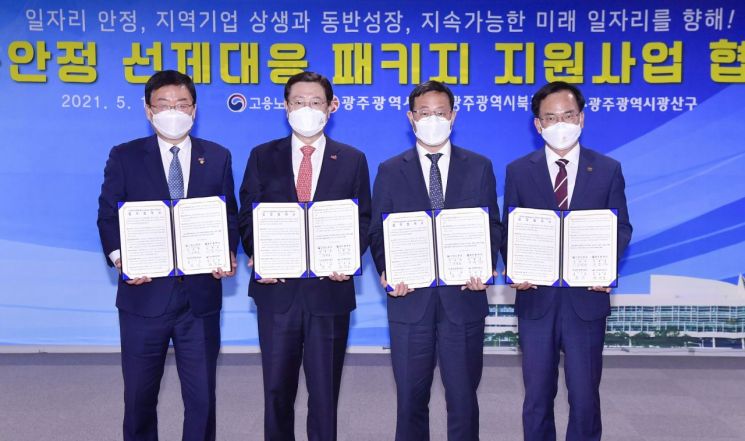 On the afternoon of the 13th, Lee Yong-seop, Mayor of Gwangju Metropolitan City, took a commemorative photo after signing a business agreement for the "Employment Stability Preemptive Response Package Support Project" with Moon In, Buk-gu District Mayor, Kim Sam-ho, Gwangsan-gu District Mayor, and Kim Young-jung, Director of Employment Policy at the Ministry of Employment and Labor, in the city hall's medium conference room. Photo by Gwangju Metropolitan City
[Asia Economy Honam Reporting Headquarters Reporter Park Seon-gang] Gwangju Metropolitan City has joined hands with the Ministry of Employment and Labor to take proactive measures for job stability and the creation of new jobs through the ‘Employment Stability Preemptive Response Package Project.’
On the afternoon of the 13th, Gwangju Mayor Lee Yong-seop, Buk-gu District Mayor Moon In, Gwangsan-gu District Mayor Kim Sam-ho, and Kim Young-jung, Director of Employment Policy at the Ministry of Employment and Labor, attended a signing ceremony for the ‘Employment Stability Preemptive Response Package Support Project’ agreement held in the city hall’s main conference room.
The ‘Employment Stability Preemptive Response Package Support Project’ is a mid- to long-term job project by the Ministry of Employment and Labor aimed at proactively responding to employment crises rather than providing retrospective support through designation of employment crisis areas. Gwangju Metropolitan City, Buk-gu, and Gwangsan-gu participated as a consortium and were finally selected.
From February to April, through consulting with the Ministry of Employment and Labor and the Korea Employment Information Service, three projects were developed: ▲Home Appliance Company Synergy-up Job Creation ▲Automobile Industry Reload Competitiveness Enhancement ▲Activation of Employment Stability Governance. These projects aim to stabilize employment in key industries and prepare new growth engines for local companies through the package project.
Gwangju’s automobile industry is a very important sector, accounting for 45% of the local manufacturing production value. However, due to a decrease in finished car production (540,000 units in 2014 → 440,000 units in 2020), the management of parts companies has deteriorated. The concentrated industrial structure means that if a crisis occurs, it is highly likely to affect the entire regional economy.
Additionally, the home appliance industry is facing increasing difficulties for partner companies due to the continuous overseas relocation of large corporations, and these management difficulties are directly linked to employment crises for workers.
In particular, Gwangju saw about 750 workers laid off last year due to closures, bankruptcies, and worsening management in the home appliance industry, highlighting the need for active support policies for these at-risk workers.
Accordingly, the city plans to invest a total of 46.6 billion KRW over five years until 2025, aiming to create 5,665 jobs through proactive responses to the stagnation and job losses in key industries (automobile and home appliances) to ensure employment stability and job creation.
This year, 8.85 billion KRW will be invested with a goal of creating 1,016 jobs. By advancing the automobile and home appliance industries, the project aims to strengthen the capacity to absorb at-risk workers and promote employment stability through support for skill-level-based job transitions in growth industries strategically promoted by Gwangju, such as artificial intelligence, air industry, and eco-friendly automobiles.
Kim Young-jung, Director of Employment Policy at the Ministry of Employment and Labor, said, “We hope that Gwangju’s Employment Stability Preemptive Response Package Project will become a sustainable job creation initiative and a new growth engine for Gwangju, helping to overcome the employment crisis caused by the COVID-19 pandemic and the transition from internal combustion vehicles to eco-friendly industries.”
Mayor Lee Yong-seop stated, “We will focus as much as possible on proactively responding to industrial structural changes such as the 4th Industrial Revolution and the transition to eco-friendly vehicles, and on the rapid employment stabilization of those who have lost or are expected to lose their jobs as a result. The local government will do its utmost to make this a best practice.”
© The Asia Business Daily(www.asiae.co.kr). All rights reserved.

















