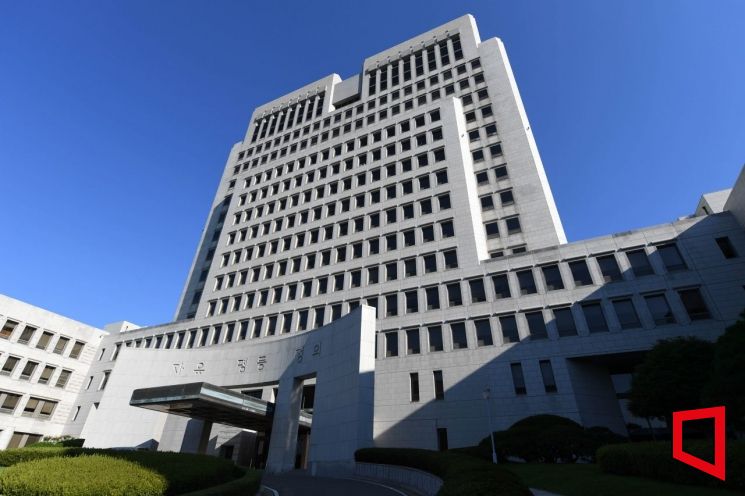
 Supreme Court, Seocho-dong, Seoul. Photo by Mun Ho-nam munonam@
[Asia Economy Reporter Kim Daehyun] The Supreme Court has ruled that if certain testimony changes in court are not directly related to the main content of a sexual harassment case, the credibility of the victim's testimony should not be dismissed. Considering that victims of sexual violence cases have frequently been exposed to 'secondary victimization,' the ruling emphasizes the need to fully consider the specific circumstances of each individual victim.
On the 13th, the Supreme Court's 2nd Division (Presiding Justice Park Sang-ok) announced that it overturned the lower court's ruling which acquitted former Air Force Lieutenant Colonel A of charges including violation of the Sexual Violence Punishment Act (sexual harassment by abuse of authority), false accusation, and subornation of perjury, and remanded the case to the Cheongju District Court.
A was prosecuted on charges of touching the knee and hand of female Sergeant B inappropriately in a taxi returning to the barracks after a unit dinner in 2014. After getting off the taxi, he appeared intoxicated and swayed, leading B to support him, during which he was investigated to have wrapped his arms around B's waist.
A, who was disciplined and dismissed in connection with the harassment incident, was also charged with false accusation, claiming that B gave false testimony, and with subornation of perjury for instructing the owner of the restaurant where the dinner took place to falsely testify that "A was seen sitting in the front seat."
The first trial court found A guilty on all charges and sentenced him to one year in prison. The restaurant owner, who was also prosecuted, was fined 1 million won for perjury.
The appellate court recognized only the charge of subornation of perjury against A, sentencing him to a fine of 5 million won, and acquitted him of the sexual harassment and false accusation charges. The court mainly based its decision on the fact that B's testimony regarding the circumstances before and after the harassment had some inconsistencies. The court stated, "B's testimony is contradictory and lacks consistency, and the content of the testimony is difficult to accept as reasonable, thus it cannot be deemed credible."
However, the Supreme Court ordered a retrial and reconsideration of the case. The court stated, "B's testimony is consistent in its main parts," and added, "Unless there is a clear motive or reason for B to give false testimony detrimental to A, the credibility of the testimony should not be lightly dismissed solely because of minor inconsistencies."
Furthermore, "B testified multiple times over more than three years, from military investigative agencies to the appellate court, regarding A's harassment," and criticized, "The appellate court doubted the credibility of the victim's testimony based only on peripheral matters not directly related to the charges, thereby rejecting its evidentiary value and acquitting all charges of false accusation."
© The Asia Business Daily(www.asiae.co.kr). All rights reserved.
















