Decline for Two Consecutive Days After Peak on the 10th
Short-Term Volatility Expands Due to Inflation Concerns
Exchange Rate Rises, Foreign Investor Outflow Expected
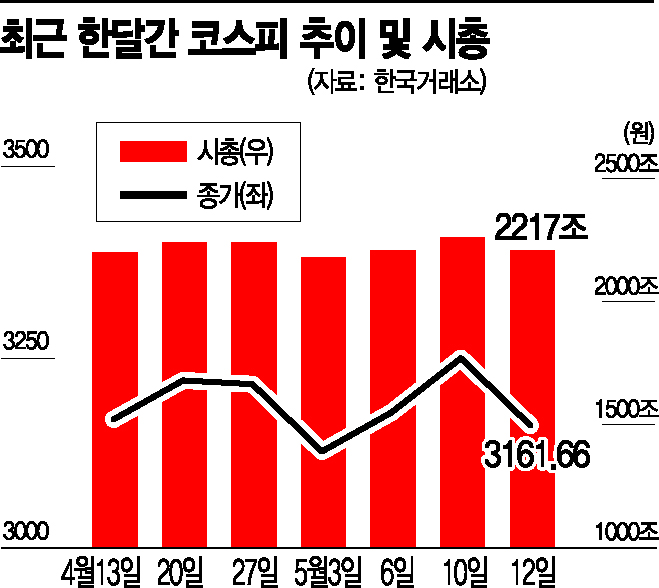
[Asia Economy Reporters Song Hwajeong, Kim Eunbyeol] After the KOSPI reached an all-time high, it recorded a decline of over 1% for two consecutive days, resulting in a market capitalization evaporation of 50 trillion won. As concerns over inflation grow, short-term volatility in the stock market is expected to expand inevitably. The won-dollar exchange rate is also rising, which is likely to lead to continued foreign investor outflows.
As of 9:05 a.m. on the 13th, the KOSPI stood at 3,124.33, down 37.33 points (1.18%) from the previous day. This marks the third consecutive day of a decline exceeding 1%. The KOSPI closed at 3,249.30 on the 10th, setting a new all-time high after two weeks, but then experienced a decline of over 1% for two consecutive days. Market capitalization also evaporated by 50 trillion won over these two days. On the 10th, the KOSPI's market capitalization reached a record high of 2,267 trillion won but decreased to 2,217 trillion won after two days of decline.
Weakness in technology stocks due to the increase in COVID-19 cases in Taiwan and inflation concerns have hindered the KOSPI. The Taiwan Weighted Index closed down 4.11% the previous day, having plunged more than 8% during the session. Inaye Lee, a researcher at Korea Investment & Securities, analyzed, "Concerns over the spread of community COVID-19 infections in Taiwan and foreign investor outflows are once again increasing volatility in the domestic stock market. The expansion of community infections in Taiwan has raised worries about disruptions in the global IT supply chain, which further weakened the preference for technology stocks that had recently been recovering, leading to a sharp drop in the Taiwan Weighted Index and weakness in the KOSPI."
Inflation concerns continue to impact the stock market. The U.S. Consumer Price Index (CPI) for April rose 4.2% year-on-year, exceeding market expectations of 3.6%. Consequently, the U.S. 10-year Treasury yield surged, and the New York stock market showed a decline of around 2%. Ha Daehun, a researcher at SK Securities, explained, "Although the U.S. Federal Reserve (Fed) is trying to quell inflation concerns, the market has now accepted inflation as a given and has begun preparing for tightening. Since the stock market has risen on liquidity momentum, a weakening of this momentum is negative for the stock market."
Volatility expansion is expected to be inevitable for the time being. The researcher added, "Fear of inflation is serving as a pretext for profit-taking, and since inflationary pressures are expected to persist for some time, an expansion of volatility seems unavoidable in the near term."
Amid inflation fears originating from the U.S., the value of the dollar has sharply risen, and as of 9:05 a.m. on the 13th, the won-dollar exchange rate in the Seoul foreign exchange market surged significantly. The won-dollar rate stood at 1,132.1 won per dollar, up 7.4 won from the previous day's closing price. The exchange rate initially rose to 1,133.3 won early in the session but slightly eased and is trading in the low 1,130 won range.
This is due to the stronger-than-expected rise in the U.S. CPI, which heightened inflation sentiment, causing a sharp increase in Treasury yields (and a drop in bond prices), and the dollar also strengthened in tandem with bond yields.
If inflation concerns reduce risk asset preference, foreign capital will flow out of the domestic stock market, and the attractiveness of the won will decline, maintaining a higher exchange rate for some time. Min Kyungwon, a researcher at Woori Bank, said, "There is a high possibility of continued foreign capital outflows from the domestic stock market, and combined with the dollar's strength due to risk aversion, the won-dollar exchange rate, which had been confined to a narrow range, is rising."
© The Asia Business Daily(www.asiae.co.kr). All rights reserved.

















