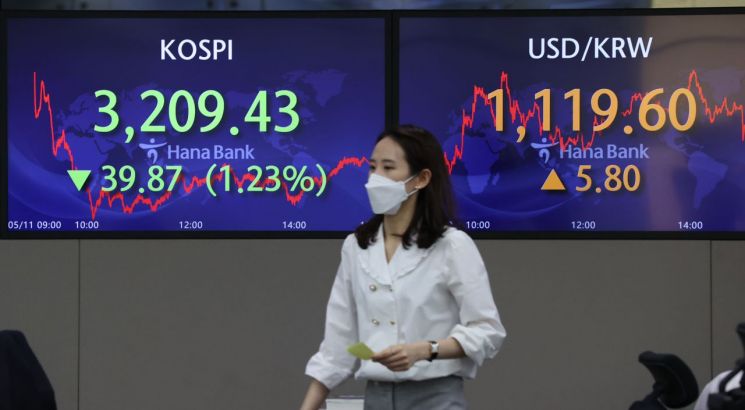
[Asia Economy Reporter Lee Seon-ae] On the 12th, the domestic stock market declined. Although the drop widened during the session to about 2%, it narrowed slightly to close with a 1% decline due to a late-session rebound buying. While individual investors absorbed the heavy selling from foreigners and institutions, it was insufficient to calm market anxiety.
According to the Korea Exchange, the KOSPI index closed at 3,161.66, down 47.77 points (1.49%) from the previous day.
Individuals were net buyers of 2.9824 trillion KRW, while foreigners and institutions were net sellers of 2.7033 trillion KRW and 250.9 billion KRW, respectively. In effect, individuals absorbed nearly 3 trillion KRW worth of selling pressure from foreigners and institutions.
Among the top market capitalization stocks on the KOSPI, LG Chem (-5.27%), Shinhan Financial Group (-4.11%), and Samsung Electro-Mechanics (-6.25%) declined, whereas Samsung Biologics (4.77%), KT (2.79%), and Green Cross (2.93%) showed notable gains. In particular, Samsung Electronics fell to the 70,000 KRW level during the session. This was the first time in over four months since December 30 of last year that Samsung Electronics dropped below 80,000 KRW intraday.
By sector, most sectors closed lower, including construction (-3.24%), chemicals (-2.81%), and electric and gas utilities (-2.42%), while only a few sectors such as transportation and warehousing (+1.33%), pharmaceuticals (+0.44%), and transportation equipment (+0.17%) showed strength.
The KOSDAQ index also closed lower at 967.10, down 11.51 points (1.18%) from the previous day. Individuals bought 235 billion KRW, while foreigners and institutions sold 168.8 billion KRW and 59.1 billion KRW, respectively. By sector, most sectors declined, including construction (-2.52%), telecommunication services (-2.52%), and transportation (-2.33%), while only a few sectors such as finance (+2.01%), food and tobacco (+0.93%), and textiles and apparel (+0.35%) showed gains.
Seo Sang-young, a researcher at Mirae Asset Securities, explained, "The Korean stock market initially rebounded due to a buying surge following the previous day's decline, but as foreign net selling and futures net selling expanded ahead of the options expiration date, the decline widened again." He added, "Especially, the Taiwanese and Japanese stock markets continued to widen their losses today following yesterday, showing weakness in neighboring countries' stock markets, which also contributed to the expanded decline."
© The Asia Business Daily(www.asiae.co.kr). All rights reserved.

















