Recent Popularity of Delivery App Platform 'Baedal Partner'
Work Orders Received and Rewards Given After App Registration
Known as 'Gig Economy' in US and UK... Already a Social Phenomenon
"Increased Worker Choice" vs "Ultimately Low-Wage Jobs"
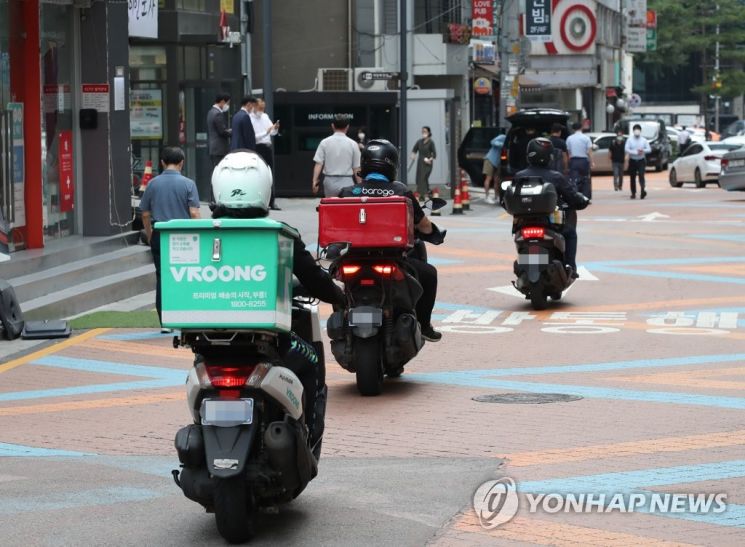 Delivery platform workers moving near Gangnam Station, Seoul. The photo is unrelated to specific expressions in the article. / Photo by Yonhap News
[Asia Economy Reporter Lim Ju-hyung] #Kim Mo (29), a freelancer living in Seoul, recently became interested in the 'delivery partner' positions recruited through delivery application (app) platforms. Kim said, "I was attracted by the fact that I can easily do delivery work on foot without a car or motorcycle," adding, "With the current COVID-19 situation and a lack of incoming jobs, I am thinking of trying it out to earn some pocket money."
The concept of 'delivery partners,' who receive payment per delivery task rather than being employed by a company and paid hourly wages, is gaining popularity in South Korea. This type of employment has long been a social phenomenon in Western countries such as the United States and the United Kingdom, where it is called the 'gig economy'?an economy based on ultra-short-term contract labor. In South Korea, it has been spreading rapidly since the COVID-19 pandemic.
The advantage of the gig economy is flexibility, making it attractive because anyone can work and earn money during their preferred hours. However, concerns have been raised that ultra-short-term part-time jobs like those in the gig economy could actually deteriorate the quality of labor.
Delivery partners are being competitively introduced by well-known domestic delivery companies such as Coupang Eats, Baedal Minjok, and GS Retail. The biggest difference between delivery partners and regular delivery company employees is flexibility. Typically, company employees work during fixed hours and receive hourly wages for their assigned tasks.
On the other hand, delivery partners are ordinary people who register through a simple process on an app, then 'choose' delivery tasks that come in, complete them, and receive payment. In other words, it is a part-time job where both the working days and hours can be set according to one’s own will.
Once a task is selected, the delivery partner picks up the delivery items from a designated location and delivers them to the customer. Delivery methods vary widely, from cars and motorcycles to bicycles and on foot.
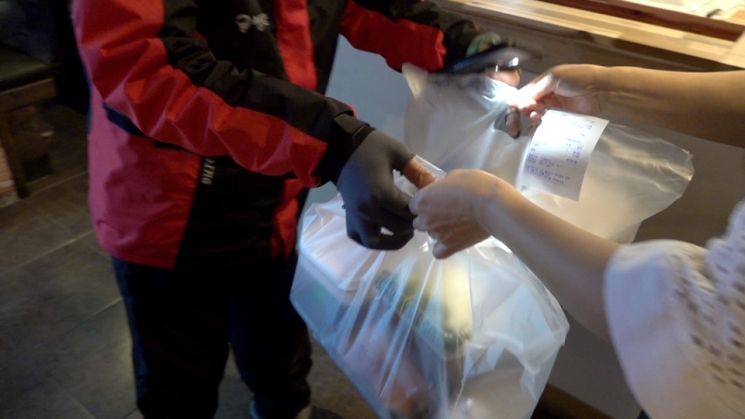 Delivery partners are ordinary people who register as partners on the application (app) and then receive tasks they want. The photo is unrelated to any specific expression in the article. Photo by Yonhap News
The number of delivery partners has increased significantly over the past year. The number of Baedal Minjok partners grew nearly fivefold from about 10,000 at the end of 2019 to 50,000 by the end of last year. GS Retail’s 'Our Neighborhood Delivery' recorded over 10,000 subscribers by December last year and surged to 70,000 by April.
Partners operated by delivery app platforms are already a familiar concept overseas. Known as the 'gig economy,' it is mainly active in the e-commerce industry.
Representative delivery app startups such as the U.S. 'Uber Eats,' 'DoorDash,' and the U.K.'s 'Deliveroo' have actively utilized the gig economy to achieve rapid growth. Among them, Deliveroo was listed on the London Stock Exchange (LSE) in April and, as of the 12th, has a market capitalization of ?4.57 billion (approximately 7.25 trillion KRW), becoming a major corporation.
Regarding the gig economy, which has become a social phenomenon beyond a simple employment form, opinions among citizens are divided. Some evaluate that delivery companies, which need to form a huge labor pool for smooth delivery services, and workers who urgently need money can achieve a win-win situation. On the other hand, concerns have been raised that the gig economy could significantly worsen the quality of labor and employment in the future.
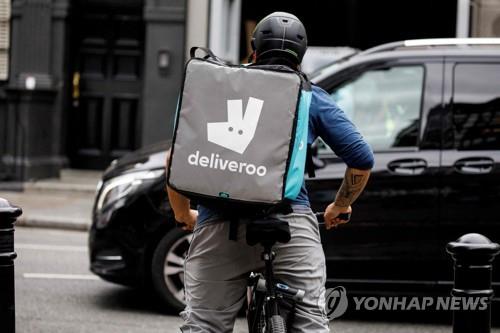 The UK delivery app platform 'Deliveroo' has experienced rapid growth through the gig economy and was listed on the London Stock Exchange last month. / Photo by Yonhap News
A company employee in their 20s, Mr. A, said, "It seems like the most ideal employment form for doing a second job," adding, "No one forces you to work more, and you just choose the tasks you want and get paid. I see it as a positive phenomenon that gives workers more choice."
Another office worker, Mr. B (31), said, "With businesses combining IT technology and traditional service industries, jobs are becoming 'smarter.' I think employment forms like delivery partners can benefit both companies and workers."
On the other hand, a university student, Ms. C (26), who experienced being a delivery partner during vacation, said, "Personally, I did it lightly as a way to earn pocket money, so it was comfortable," but added, "Ultimately, those who seek such jobs out of desperation are people with unstable employment and insufficient living expenses. If this type of job becomes entrenched, I worry it could lead to another form of exploitation."
Meanwhile, controversies surrounding the gig economy are not limited to South Korea. Even in Western advanced countries where ultra-short-term contract labor is common, conflicts over the employment status of gig economy workers are emerging.
 Uber drivers are cheering after hearing the favorable ruling outside the London Supreme Court on February 19th (local time). / Photo by Yonhap News
Earlier, on February 16 (local time), the UK Supreme Court ruled that workers at the British branch of the world's largest ride-sharing company, Uber Technologies, should be classified as regular employees rather than contract workers.
Uber operates by contracting with workers through an app and paying them accordingly. The Supreme Court judged that workers are directly employed by Uber while logged into the app. As a result, Uber must now guarantee minimum wage, holiday pay, pensions, and other benefits to workers in the UK.
In March, the Spanish government became the first European country to announce legislation recognizing legal rights for workers contracted through gig economy platforms.
Yolanda D?az, Spain’s Minister of Labor, stated at the time, "Spain will be the first EU country to legally regulate issues related to gig economy and platform workers," emphasizing, "Platform workers such as delivery drivers are 'employed workers' with rightful rights and should receive social protections that they currently lack."
© The Asia Business Daily(www.asiae.co.kr). All rights reserved.



















