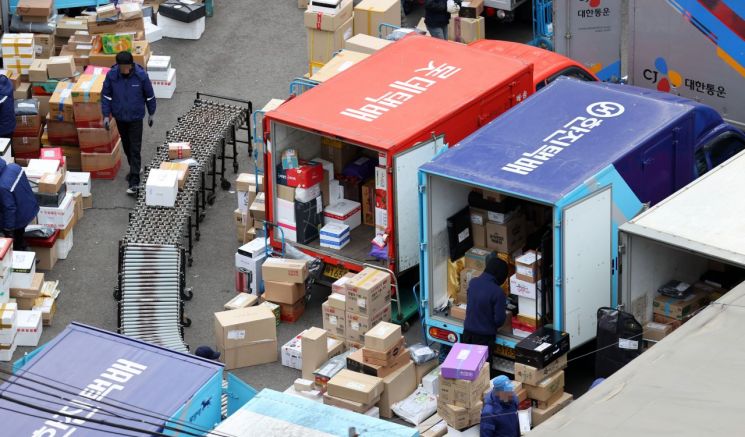
[Asia Economy Reporter Jeong Dong-hoon] Since COVID-19, the delivery labor union and companies, who have been continuously conflicted over improving working conditions, have repeatedly gone on strike and withdrawn strikes. Amid these conflicts, delivery fees have steadily increased, leading to criticism that consumers are ultimately bearing the burden of the delivery labor disputes.
According to the government and the National Delivery Workers' Union (Delivery Union) on the 12th, the so-called "Consultative Body for Solving Delivery Issues in Ground Park-type Apartments (Consultative Body)" is expected to hold its first meeting within this week. It is known that the government proposed the formation of the Consultative Body to the Delivery Union on the 10th, after the union decided on a general strike. The Consultative Body is reported to include representatives from the government, delivery companies, and the Delivery Union. The Delivery Union initially announced a general strike on the 11th but temporarily postponed it following the government's proposal.
As a result, the number of government-delivery labor consultative bodies aimed at improving delivery workers' working conditions is expected to increase to two. After a series of deaths presumed to be from overwork among delivery workers last October and the issue of sorting work came under scrutiny, the government and delivery labor formed the "Delivery Workers Overwork Prevention Measures Council" and held several meetings. Through various issues such as responsibility for sorting work and vehicle control in park-type apartments, the industry has reached the conclusion of "delivery fee increases." Only stakeholders such as the government, delivery companies, labor unions, and sales offices participate in the consultative bodies, with no representatives to voice consumer interests. If they conclude on raising delivery fees, it is difficult to reflect the voices of consumers who bear the burden. Although fee increases are necessary for improving working conditions, there is criticism that the process of raising delivery fees is repeated without considerations such as management efficiency.
The Delivery Union, which demands improvements in working conditions, also considers delivery fee increases a realistic method. At the general strike declaration on the 7th, the Delivery Union stated, "Delivery companies should urgently prepare measures such as designating apartments that restrict ground-level access as non-delivery zones and charging additional fees." Delivery companies have raised delivery fees for individual customers consecutively earlier this year and last month. Professor Eunhee Lee of Inha University's Department of Consumer Studies said, "It is desirable to reduce costs and operate companies through management innovation," adding, "It is not appropriate to fully pass on the burden of increased delivery fees, which are necessary to resolve delivery workers' excessive workloads, to consumers."
© The Asia Business Daily(www.asiae.co.kr). All rights reserved.
![Clutching a Stolen Dior Bag, Saying "I Hate Being Poor but Real"... The Grotesque Con of a "Human Knockoff" [Slate]](https://cwcontent.asiae.co.kr/asiaresize/183/2026021902243444107_1771435474.jpg)
















