Vaccine Controversy Continues with Cryptocurrency Holding and Trading Guidelines
Internal Dissatisfaction Boils Among Young Police Officers
Frontline Officers Say "Excessive Infringement on Personal Freedom"
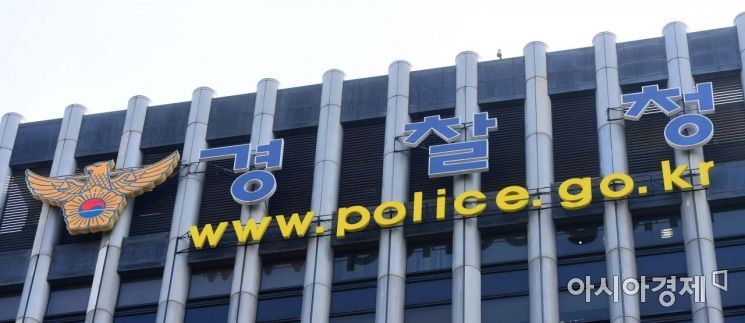
[Asia Economy Reporter Song Seung-yoon] The police force is in turmoil due to 'vaccines' and 'coins.' Amid ongoing controversy over the police leadership effectively coercing vaccination, internal dissatisfaction is growing following the issuance of a virtual currency ban.
The National Police Agency recently notified frontline units of the 'Virtual Currency Holding and Trading Guidelines.' The core of the directive prohibits employees working in investigation and audit departments from acquiring new virtual currencies. Existing virtual currencies must also be reported. Although this measure applies only to those in investigation and audit departments, other employees who use internal information to invest or invest excessively may also face disciplinary action depending on the circumstances.
Opinions within the police are divided. Considering the investigative nature such as raids on cryptocurrency exchanges, some see the measure as unavoidable for certain departments, but most think it is excessive. Among police officers in their 20s and 30s, who are the main investors in virtual currencies, this sentiment is even stronger. They argue that since trading virtual currencies is not illegal, this excessively infringes on personal property rights. Lieutenant A from a frontline police station in the Gyeonggi region said, "There was a directive telling even employees not in investigative departments to refrain, so it is true that there is pressure," adding, "I think from now on, employees will completely avoid discussing investments among themselves."
Given that there was already noise surrounding vaccine administration, distrust toward the leadership has intensified. Previously, criticism was raised within the police that the leadership effectively coerced COVID-19 vaccination.

Controversy grew as posts criticizing the leadership appeared one after another on the police internal network. On the 30th of last month, a police officer filed a complaint with the Human Rights Commission alleging that the police leadership violated employees' human rights. Sergeant A of the Seoul Metropolitan Police Agency said, "Although they said (vaccination) was a personal freedom, there was unspoken pressure from above like 'Choose wisely' and 'What will you do if even one person gets infected?'" He added, "Salaries for public officials are fixed, but now they are even monitoring personal investments, so everyone is questioning whether this is really a democratic country."
A senior officer at a local police agency said, "I understand that dissatisfaction has recently erupted among young police officers," but added, "However, vaccination is essential for police duty performance and the safety of other employees, and I understood the virtual currency guidelines as aiming to maintain at least a reasonable standard."
According to the National Police Agency, from the 26th of last month to the 8th of this month, during the two-week period of the first dose of the AstraZeneca (AZ) vaccine, 84,324 out of 117,579 police employees aged 30 and above (71.72%) were vaccinated. Among 85,441 who made prior reservations for vaccination, 98.7% received the vaccine. The police have decided to support applications for national compensation for employees who experience adverse reactions after receiving the COVID-19 vaccine.
© The Asia Business Daily(www.asiae.co.kr). All rights reserved.


















