Village Communities Participate Autonomously in Lifestyle Changes to Reduce Greenhouse Gas Emissions in Daily Life
Stepwise Support for Greenhouse Gas Reduction Project Funds Over 3 Years in Low-Carbon Green Living Practice Villages
[Asia Economy Yeongnam Reporting Headquarters Reporter Kim Yong-woo] There are successful low-carbon villages where residents directly participate to reduce carbon emissions.
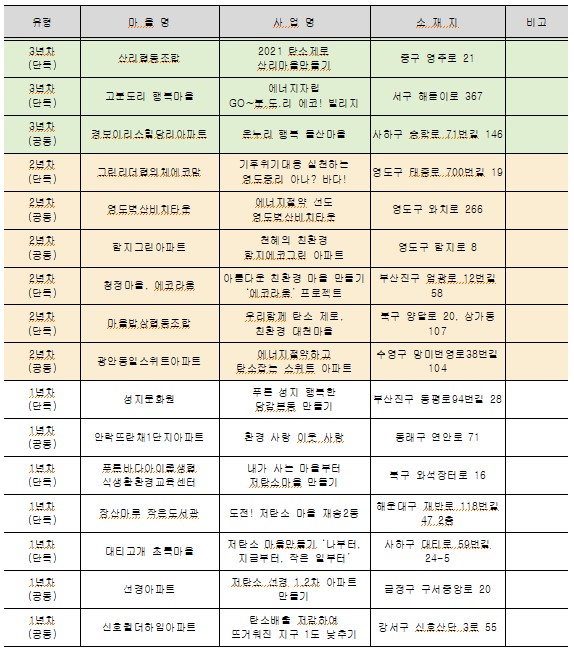
Busan City (Mayor Park Hyung-jun) has selected 16 “Busan-style low-carbon villages” that encourage citizens to practice greenhouse gas reduction in daily life through citizen-led participation and autonomous changes in village community lifestyles.
The Busan-style low-carbon village project is a non-industrial sector initiative that costs less than the industrial sector but shows immediate greenhouse gas reduction effects.
It is a method that induces and supports all village residents to improve their lifestyle habits to reduce greenhouse gases.
Once selected as a low-carbon village, the village receives subsidies and support for village activists for three years to carry out the project step by step.
▲ In the first year, residents receive projects focused on awareness changes such as setting energy-saving goals, climate change education, and household greenhouse gas diagnosis and consulting (subsidy of 2 to 3 million KRW).
▲ In the second year, efficiency improvement projects such as building insulation, boiler cleaning, water-saving facilities, and replacement of high-efficiency (LED) lighting are carried out (subsidy of 4 to 5 million KRW), and ▲ in the third year, carbon-zero projects through carbon offset such as installing mini solar panels and rainwater barrels in houses and planting trees are promoted (subsidy of 6 to 7 million KRW).
The places selected this time are ▲ Seongyeong Apartment ▲ Pureunbada iCOOP Food Education Center ▲ Seongji Cultural Center ▲ Jangsanmaru Small Library ▲ Daetigogae Green Village ▲ Anrak Tteuranchae 1st Complex Apartment ▲ Sinho Wilderheim Apartment (all first year) ▲ Green Leader Council Eco Mom ▲ Yeongdo Byeoksan Beach Town ▲ Hamji Green Apartment ▲ Village Table Cooperative ▲ Clean Village Eco Raum ▲ Wuil Sub Gwangandong Dongil Suite (all second year) ▲ Gobundori Happy Village ▲ Gyeongbo Iris Hill Dangri Apartment ▲ Sanri Cooperative (all third year), totaling 16 places.
From 2016 to 2020, a total of 53 villages have been selected and operated as low-carbon villages, achieving a reduction of 407 tons of greenhouse gases so far.
▲ Seokpo Village in Nam-gu (representative Kim Myung-chul) ▲ Hakjang Samsung 2nd Apartment in Sasang-gu (representative Kim Gwi-jun) ▲ Hanshin Green Core Apartment in Gijang-gun (representative Park Hong-eun) are three places that have continued to practice low-carbon living even after completing the three-year project. They are cited as good examples showing that the lifestyle habits of village residents have changed.
Busan Mayor Park Hyung-jun explained, “Low-carbon villages are projects that change small ways of life to save energy and resources,” adding, “They not only reduce greenhouse gases, which are the cause of climate change, but also enhance national competitiveness and protect the Earth, the home for future generations, creating more than triple the effect.”
© The Asia Business Daily(www.asiae.co.kr). All rights reserved.
![Clutching a Stolen Dior Bag, Saying "I Hate Being Poor but Real"... The Grotesque Con of a "Human Knockoff" [Slate]](https://cwcontent.asiae.co.kr/asiaresize/183/2026021902243444107_1771435474.jpg)
















