Large-scale Foreign Sell-off... Samsung Electronics Already Net Sold Over 1 Trillion Won
SK Hynix Drops Over 5%, Biggest One-day Decline Since April Last Year
Sold Over 400 Billion Won Previous Day... Sets New Record for Largest One-day Net Sell-off
[Asia Economy Reporter Minwoo Lee] The stock prices of leading semiconductor companies have struggled to recover amid a selling spree by foreign investors. Despite the solid demand for semiconductors, there are expectations that stock prices will rebound starting in the second quarter due to improved cost structures and better earnings.
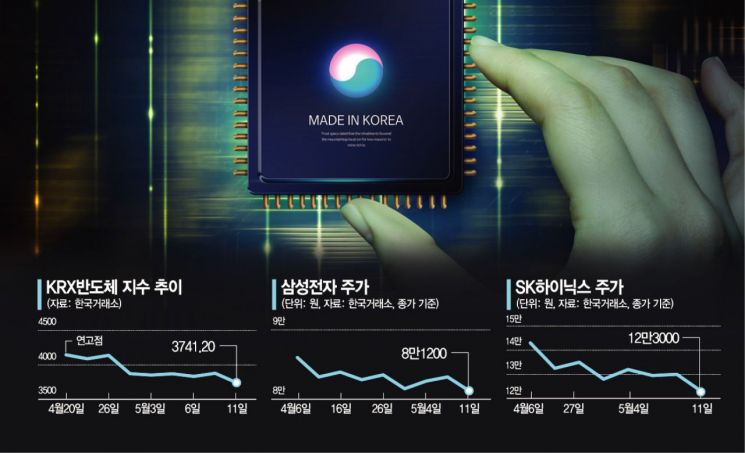
According to the Korea Exchange on the 12th, Samsung Electronics closed at 81,200 KRW, down 2.40% from the previous trading day. This marked the largest single-day drop since January 30 this year. The decline is attributed to net selling by both foreign and institutional investors.
In particular, foreign investors' selling pressure was significant. They sold 792 billion KRW worth of shares in a single day. This was not only the largest net selling by foreigners on that day but also the biggest single-day net selling since February 26 (833.9 billion KRW). Since the beginning of this month until the previous day, foreign investors have already disposed of 1.1525 trillion KRW worth of Samsung Electronics shares, nearly three times the total foreign net selling amount of 394.8 billion KRW last month. As of 11:17 AM on the day, the stock price remained weak, recording 80,500 KRW, down 0.86% from the previous day.
SK Hynix also showed a similar decline. The stock price closed at 123,000 KRW, down 5.38% from the previous trading day. This was the largest drop since April 1 last year (-5.88%), when the domestic stock market was hit hard by COVID-19. The selling spree by foreign investors was again a major factor, with net sales of 414.3 billion KRW in a single day. This set a new record for the largest single-day net selling since the Korea Exchange began compiling data in 1999. The previous record was 364.7 billion KRW on February 26. As of 11:17 AM on the day, the stock price was 121,500 KRW, down 1.22% from the previous day.
As the leading semiconductor stocks faltered, the KRX Semiconductor Index also declined. It hit a yearly high of 4146.24 on the 20th of last month but plunged nearly 10% to 3741.20 the previous day. This contrasts with the KOSPI, which only fell about 0.3% during the same period.
The drop is analyzed to be influenced by concerns over inflation in the U.S., which triggered a 4.66% plunge in the Philadelphia Semiconductor Index (SOX) in a single day on the 10th (local time). All 30 stocks included in the index fell, impacting the domestic market as well. Particularly, despite companies increasing investments amid ongoing semiconductor supply shortages, this has been interpreted as a sign of potential oversupply in the future. Minseong Hwang, a researcher at Samsung Securities, explained, "The supply shortage is normalizing with increased supply, but demand has either been pulled forward or there are concerns about a decline in speculative demand. This has spread a sentiment that the burden of increased supply will grow in the second half of the year."
However, from the second quarter onward, the effect of improved cost structures is expected to lead to a substantial improvement in earnings, resulting in a stock price rebound. Wonsik Lee, a researcher at Korea Investment & Securities, said, "Samsung Electronics is expected to reduce costs by up to 10% in both the DRAM and NAND sectors this year. With an expanded increase in DRAM prices and a turnaround in NAND prices, earnings are expected to improve by 6% in the second quarter and 40% in the third quarter compared to the previous quarter."
SK Hynix is also expected to rebound toward the end of the year. Doyeon Choi, a research fellow at Shinhan Financial Investment, forecasted, "Demand is expected to increase in the second quarter, mainly driven by servers, and foundry companies will efficiently allocate volumes, easing supply shortages. As concerns that had been priced into the stock are resolved, a sharp rise is expected in the third and fourth quarters."
© The Asia Business Daily(www.asiae.co.kr). All rights reserved.
![Clutching a Stolen Dior Bag, Saying "I Hate Being Poor but Real"... The Grotesque Con of a "Human Knockoff" [Slate]](https://cwcontent.asiae.co.kr/asiaresize/183/2026021902243444107_1771435474.jpg)











