80% of Pregnancy Terminations Choose Surgery
Surgical Costs 800,000~1,000,000 KRW in Last 2 Years
Non-Capital Areas Face Difficulty Finding Hospitals
Confusion Worsens Due to Lack of Alternative Legislation
Calls Grow for Healthcare System Reorganization
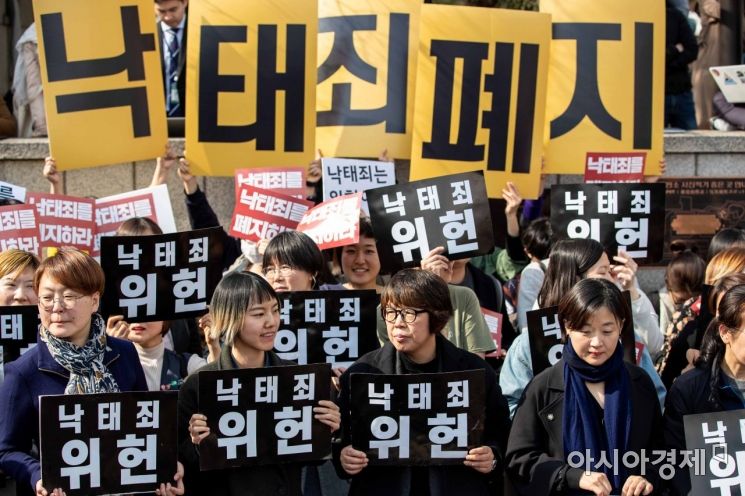 On April 11, 2019, in front of the Constitutional Court of Korea in Seoul, female activists who had called for the unconstitutionality of the abortion law cheered after hearing the ruling declaring the abortion law unconstitutional. Photo by Jinhyung Kang aymsdream@
[Asia Economy Reporter Han Jinju] Women seeking medical institutions for pregnancy termination felt disheartened upon hearing such remarks. They are exposed to poor conditions without proper protection of their rights due to lack of accurate medical information and doctors refusing treatment. Although the abortion law was ruled unconstitutional over a year ago, confusion continues due to the absence of substitute legislation.
Finding hospitals is difficult and costs are increasing
According to the "Study on Enhancing Medical Accessibility for Safe Pregnancy Termination" conducted by the Korea Women's Policy Research Institute from January 2016 to March this year targeting 602 women aged 19-44 who experienced pregnancy termination, 189 respondents (21%) used medication (including overlapping surgery) for termination, while 477 (79%) underwent surgical termination. The cost of hospital-prescribed medication usually ranged from 300,000 to 400,000 KRW, and surgery typically cost between 500,000 and 800,000 KRW. Regarding medication costs, 64.4% felt burdened, and 81.6% felt burdened by surgery costs.
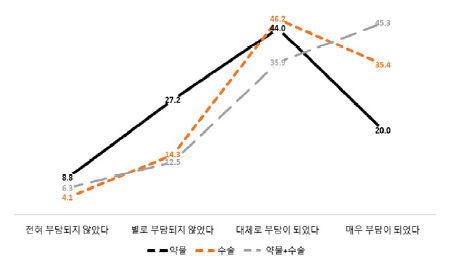 60 to 80% of women responded that they feel burdened by the medical costs of pregnancy termination. (Source: Korean Women's Development Institute, "Study on Enhancing Medical Accessibility for Safe Pregnancy Termination")
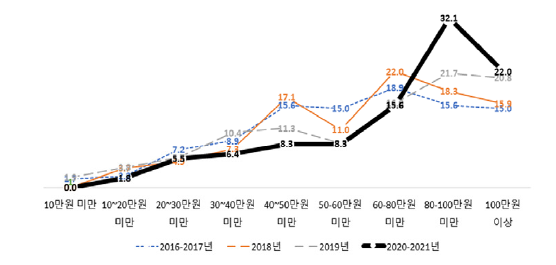 According to a survey by the Women’s Policy Institute, 32.1% of individuals who underwent abortion procedures last year and this year paid between 800,000 and 1,000,000 KRW for the surgery costs. (Source: Women’s Policy Institute, "Study on Improving Medical Accessibility for Safe Pregnancy Termination")
Those who chose surgery did so for definite termination (36.2%) or rapid termination (19.4%), or because they could not obtain medication (15.9%) or were unaware that termination was possible (19%). Most hospitals inform that surgery is only possible at hospital-level facilities equipped for delivery if the pregnancy is over 10 weeks. It is also difficult to find hospitals capable of performing surgery in non-metropolitan eup/myeon areas.
There is a growing call to guarantee access to contraception and reorganize the pregnancy termination healthcare system. Kim Dongsik, head of the Gender Violence Research Division at the Korea Women's Policy Research Institute, explained, "Emergency contraceptives should be switched to over-the-counter drugs, modern contraceptive methods should be covered by health insurance, and natural miscarriage-inducing agents should be introduced quickly so women can choose pregnancy termination according to their situation and conditions. Especially, a comprehensive reorganization of the public-private medical delivery system, including obstetrics and gynecology and pregnancy termination-capable medical institutions in non-metropolitan eup/myeon areas, is necessary." Kim Saerom, head of the Gender and Health Research Center at the Citizen Health Research Institute, said, "There is a large information gap and inappropriate information circulation before contraception or pregnancy termination stages. Especially, consideration must be given to those who find it difficult to seek medical institution information themselves, such as marriage migrant women and adolescents. Close cooperation between the Ministry of Gender Equality and Family and the Ministry of Health and Welfare is needed to improve access to pregnancy termination-related information."
Frequent refusals of prescriptions and surgeries... urgent need for legal reform

Many doctors refuse to prescribe contraceptives or perform surgeries. Apart from some cases, this is due to the illegality of abortion until recently, personal beliefs about fetal life rights, and inadequate facilities. Oh Jungwon, an obstetrician-gynecologist and member of the Women's Committee of the Practicing Doctors Association, said, "As abortion is legalized, awareness must shift so that medical staff recognize it as an essential medical service to be safely provided. Through awareness change and persuasion, resistance can be gradually transformed. The Obstetrics and Gynecology Society is discussing pregnancy termination, but the focus remains on procedures and complications," she explained.
Because pregnancy termination surgeries have been stigmatized, hospitals present different costs and add various fees, increasing the financial burden on women. Survey results show that among those who had pregnancy termination surgery last year and this year, 32.1% paid between 800,000 and 1,000,000 KRW for surgery. The medical cost for pregnancy termination allowed under the Maternal and Child Health Act is 270,000 KRW. Specialist Oh Jungwon pointed out, "Non-reimbursed medical fees are autonomously set by hospitals and influenced by inflation and social issues. Ultrasound and hospitalization fees are treated as general items, so costs inevitably more than double. This increases patients' economic burden and deprives them of sufficient medical service opportunities."
In response, the Ministry of Health and Welfare states that amendment of the Maternal and Child Health Act is necessary to set the scope of medical expenses that the government can support, such as health insurance coverage. Son Munkum, director of the Childbirth Policy Division at the Ministry of Health and Welfare, said, "Legal grounds must be clarified for health insurance policy implementation. We are discussing support measures for counseling fees to provide reliable counseling related to pregnancy maintenance and termination."
Na Young, CEO of SHARE, said, "Policies must be premised on the difficulty of distinguishing unwanted pregnancies from others and the fact that they can occur under various conditions. The less prepared one is, the more likely they are to face poor conditions."
© The Asia Business Daily(www.asiae.co.kr). All rights reserved.
![User Who Sold Erroneously Deposited Bitcoins to Repay Debt and Fund Entertainment... What Did the Supreme Court Decide in 2021? [Legal Issue Check]](https://cwcontent.asiae.co.kr/asiaresize/183/2026020910431234020_1770601391.png)


















