President Moon Jae-in Acknowledges Failure of Real Estate Policy... Officially Announces Revisions
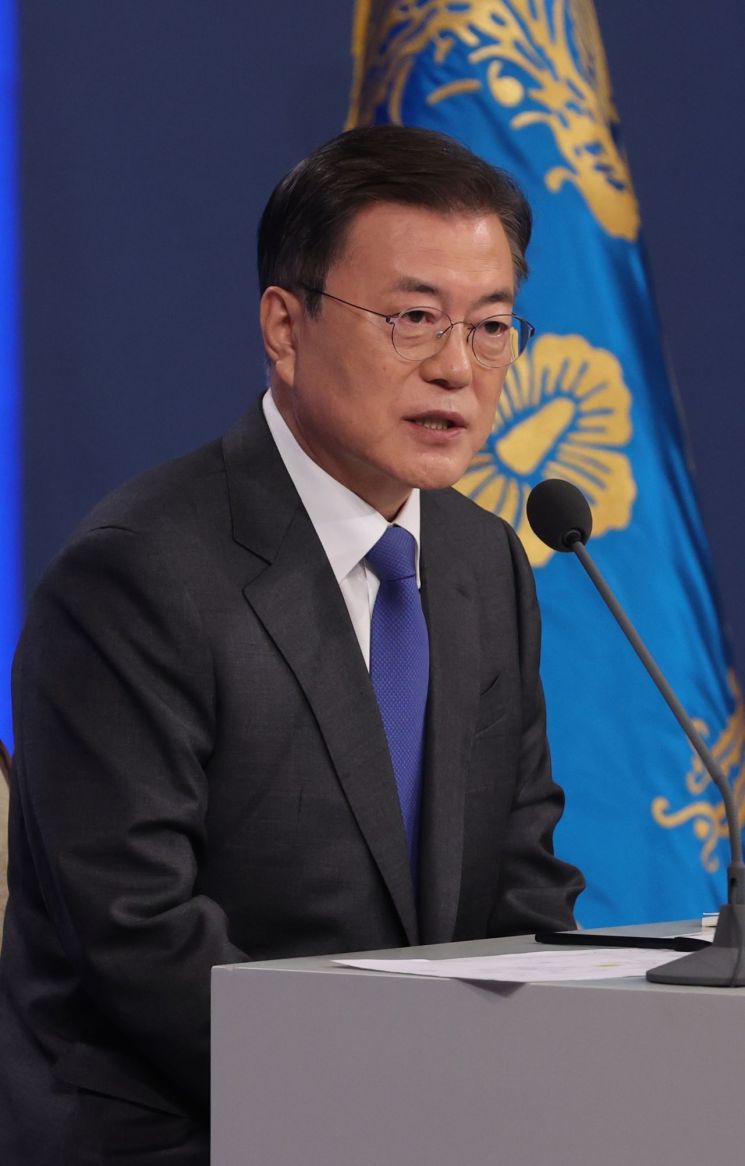
[Asia Economy Reporter Kangwook Cho] President Moon Jae-in, who acknowledged the failure of real estate policies, has officially announced plans to supplement policies by easing the burden of homeownership for actual demanders such as the homeless. This has drawn attention to specific regulatory relaxation measures. In the market, the most likely supplementary measures are considered to be easing loan regulations and tax burdens such as property taxes for actual housing demanders, including the homeless and one-home owners, which are currently being discussed by the ruling party and the government. However, since the administration has indicated that it will not change the existing real estate policy stance, there are forecasts that it will fall short of market expectations.
According to the ruling party and government on the 11th, the government and the ruling Democratic Party have begun reviewing real estate policies after the April 7 by-elections and are discussing easing loan regulations for actual demanders and reducing property taxes. Since President Moon stated in his special speech on the 4th anniversary of his inauguration and the subsequent press conference that "It is natural that efforts to review and supplement existing real estate policies are underway due to the severe judgment," it is expected that consultations between the ruling party and the government will accelerate.
The top priority for policy revision is considered to be easing loan regulations for actual housing demanders such as the homeless and one-home owners, along with reducing tax burdens such as property taxes.
The ruling party and government are considering raising the Loan-to-Value ratio (LTV) and Debt-to-Income ratio (DTI) to 60% when the homeless take out mortgage loans to buy homes. They have been increasing LTV and DTI by 10 percentage points each for the homeless, and are now considering raising them by an additional 10 percentage points. They are also reviewing raising the housing price criteria applied at this time from under 600 million KRW to under 900 million KRW, and increasing the combined annual income requirement for couples from under 80 million KRW to under 100 million KRW.
There is also interest in how much the scope of property tax reductions, which have become a heavier burden due to rising official property prices, will be expanded. A plan to raise the scope of property tax reductions for one-home households from the current under 600 million KRW to under 900 million KRW is being seriously considered. The fact that there are as many as 592,000 multi-family housing units in the 600 million to 900 million KRW price range is cited as a reason for the lack of major disagreement between the ruling and opposition parties.
For comprehensive real estate tax, micro-adjustment measures such as expanding deductions for the elderly and retired groups and introducing a tax deferral system are being discussed. On the other hand, as the number of people subject to the comprehensive real estate tax on housing this year has rapidly increased to nearly one million due to the sharp rise in housing prices, there is also speculation that the baseline will inevitably have to be raised. However, regarding market demands to adjust the pace of official price increases, it is reported that approaches to reduce burdens such as taxes and health insurance premiums are being proposed.
The market welcomes the shift from a regulation-only stance to relaxation measures. However, there are also criticisms that the effectiveness of such regulatory relaxation signals will be minimal with only one year left in the president’s term.
Seo Jin-hyung, president of the Korea Real Estate Society (professor at Gyeongin Women’s University), said, "It is questionable whether it is timely to revise the direction toward regulatory relaxation at this point," adding, "Since the supply-driven supply policy was maintained until now and only now the private sector’s supply function is being recognized, it seems more like a declarative gesture to soothe the deteriorated public opinion on real estate."
© The Asia Business Daily(www.asiae.co.kr). All rights reserved.

















