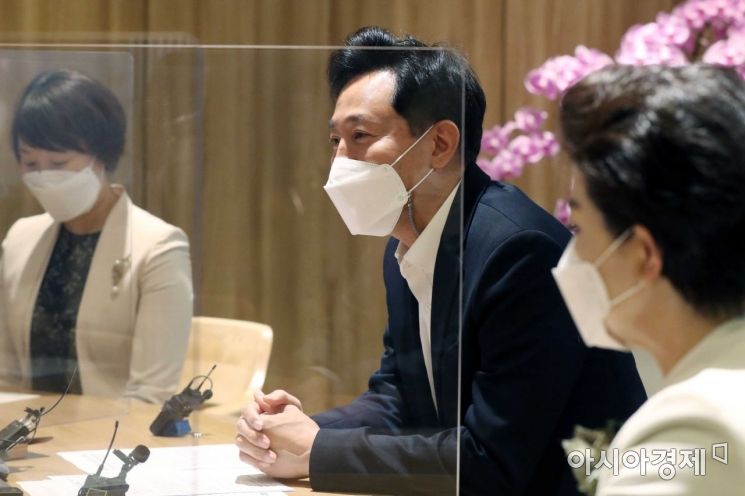
 Seoul Mayor Oh Se-hoon is giving an opening remark at a meeting with the Seoul Nursing Assistant Association held in the Mayor's Office at Seoul City Hall, Jung-gu, Seoul, on the morning of the 10th.
This meeting was organized to encourage nursing assistants working on the front lines of the COVID-19 healthcare field and to listen to their voices from the field. Photo by Kang Jin-hyung aymsdream@
[Asia Economy Reporter Kim Hyemin] The organizational restructuring plan of Seoul Mayor Oh Se-hoon, who has been in office for one month, has been unveiled. The plan focuses on strengthening the housing supply function, encompassing redevelopment and reconstruction, while significantly downsizing the urban regeneration project, a key initiative of former Mayor Park Won-soon. However, it remains uncertain whether this restructuring plan, reflecting Mayor Oh's determination, will pass the city council.
According to Seoul City on the 11th, the city announced the legislative notice on the amendment of the ordinance for the establishment of administrative organizations, enforcement rules, and the ordinance on the number of public officials on the 7th, and is collecting public opinions until today.
Due to the short one-year term, the organizational restructuring was minimized, but the real estate-related functional organizations were extensively overhauled.
First, the Housing and Architecture Headquarters, originally a level 2 division, was expanded and reorganized into the Housing Policy Office, a level 1 division. The Housing Policy Office will establish and develop housing policies and oversee all housing policies, including maintenance projects such as reconstruction, redevelopment promotion projects (commonly known as New Town), and public land development. This reflects Mayor Oh's policy intention to activate redevelopment and reconstruction to supply housing. Although this represents a retreat from his original pledge to integrate the Urban Planning Bureau and Housing and Architecture Headquarters into a mayor-direct Urban Housing Headquarters, it demonstrates his intention to expand functions and provide full administrative support.
On the other hand, the Urban Regeneration Office (level 1), newly established by former Mayor Park, was abolished. This is interpreted as a continuation of Mayor Oh's campaign statement that "if elected, I will first reform mural-style urban regeneration projects." The city decided to transfer only some functions of urban regeneration work, such as policy and residential regeneration, to the newly established Balanced Development Headquarters (level 2). The Balanced Development Headquarters will include functions such as urban regeneration, urban development projects, and balanced development between Gangnam and Gangbuk districts. The city also plans to increase related personnel by 49 to promote core projects such as housing supply, balanced development, and single-person households.
However, this organizational restructuring plan must overcome the hurdle of passing the city council. In this regard, immediately after his inauguration, the Seoul City Council expressed concerns, stating, "A large-scale organizational restructuring may destabilize ongoing projects or reduce organizational stability," and urged, "Please lead the key projects that Seoul has pursued over the past 10 years, such as urban regeneration, with continuity."
Therefore, there is a possibility of a power struggle between the city and the city council during the approval process. Seoul City is requesting a one-point special session within this month, but it is also anticipated that the plan may not be processed before the regular session on the 10th of next month.
© The Asia Business Daily(www.asiae.co.kr). All rights reserved.

















