Institute for Basic Science to Reveal Detailed Plans at Public Hearing on the 11th
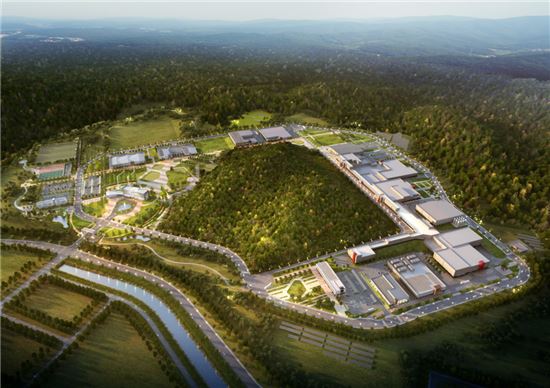 Korean-style heavy ion accelerator 'RAON' rendering (Provided by POSCO Engineering & Construction)
[Asia Economy Reporter Kim Bong-su] The government plans to complete the first phase of the 'Heavy Ion Accelerator' construction project, which has faced difficulties due to technical challenges, by the end of this year to finish the low-energy section, and to proceed with preliminary research and development (R&D) before implementing the second phase, the high-energy section.
On the afternoon of the 11th, the Ministry of Science and ICT announced on the 10th that it will hold a public hearing on the 'Detailed Implementation Plan (Draft) for the Heavy Ion Accelerator Construction Project' together with the Institute for Basic Science (IBS) to gather expert opinions on the project plan.
The government finalized the project plan in 2009 as a core facility of the 'Science Belt Project' aimed at revitalizing basic scientific research. It is a research facility that accelerates and collides various heavy ions up to uranium to alter material structures, generate rare isotopes, and utilize them in advanced basic scientific research. Initially, construction was planned on a 952,000㎡ site within the Shindong district with a scale of 130,000㎡, targeting completion by 2021. However, due to unresolved technical challenges, the plan to complete the low-energy and high-energy sections separately has been virtually confirmed.
On this day, IBS, centered on the Heavy Ion Accelerator Construction Project Group, formed a separate task force team and disclosed the detailed implementation plan (draft) divided into the first phase and the post-first phase projects. According to this, in the first phase, efforts will focus on building the low-energy accelerator, for which technology has been secured, by the end of this year, strengthening project management by proposing continuous cooperation measures for risk management and specifying critical checkpoints.
To adhere to the production and installation schedule of the low-energy accelerator, all resources including technical personnel and testing facilities will be prioritized, and monthly consultations with overseas experts will be conducted 1 to 2 times to prevent potential issues in advance. In October, an on-site inspection by an overseas accelerator expert verification team is scheduled. To successfully perform the cryogenic system cooling necessary for commissioning after construction completion, cooperation and consultation with domestic and international institutions will be conducted across the entire cryogenic system to minimize risk factors. To minimize risks in developing the high-energy accelerator, alternative designs will be pursued alongside the existing designed accelerator tubes (SSR1, SSR2).
After the first phase, the plan is to resolve technical issues of the high-energy accelerator section, whose performance has not yet been secured, through preliminary R&D to increase the likelihood of success before starting mass production and construction of the main product. During the preliminary R&D period, centered on the Heavy Ion Accelerator Construction Project Group, prototype and initial mass production of the high-energy accelerator will be developed and produced to secure manufacturing technology and establish process procedures for mass production of superconducting accelerator tubes and acceleration modules. Based on the technology secured through this process, the high-energy accelerator section will be completed during the second phase.
Choi Do-young, head of the International Science Business Belt Promotion Group, said, “The interest and advice of the scientific community are necessary to prepare a feasible detailed implementation plan,” adding, “We will transparently disclose the implementation process in the future and manage the project openly.”
© The Asia Business Daily(www.asiae.co.kr). All rights reserved.
















