More than Half of Supplies Secured from 10 Countries
Expanding Influence through 'Vaccine Diplomacy'
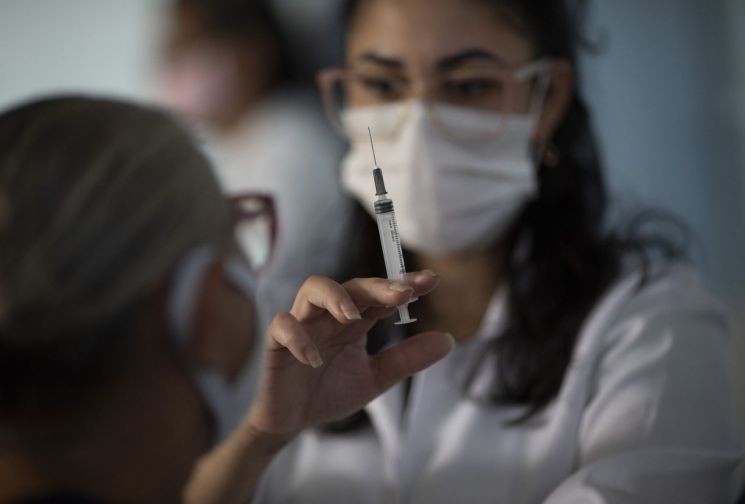
[Asia Economy Reporter Cho Hyun-ui] In Latin America, where the backlash from COVID-19 is severe, Chinese-made COVID-19 vaccines account for more than half of the supply. Analysts say that the Chinese government's so-called 'mask diplomacy' has expanded into 'vaccine diplomacy,' increasing its influence in the region.
On the 9th (local time), a foreign media outlet analyzed the COVID-19 vaccine procurement details of the top 10 Latin American countries by population and found that out of a total of 143.5 million doses, 75.8 million doses were either Chinese-made vaccines or vaccines produced using raw materials imported from China. The supply of Russian-made vaccines was 8.7 million doses, mostly concentrated in Argentina.
The major Western suppliers AstraZeneca and Pfizer provided 59 million doses. Pfizer supplied 19.5 million doses to these countries. Claire Wenham, a professor of global health policy at the London School of Economics, said, "China's influence in the global health sector is expanding."
She explained that the number of Chinese vaccines would have been even higher if there had not been a recent slowdown in supply to Brazil, Latin America's largest customer. Brazilian President Jair Bolsonaro last week said, "We do not know whether the origin of the COVID-19 virus is a laboratory or someone eating inappropriate animals, but the military knows whether it is a chemical, bacterial, or radiological warfare," and indirectly mocked China by asking, "Which country's Gross Domestic Product (GDP) has grown the most?"
Latin American countries continue to request assistance from the United States. In March, Luis Abinader, president of the Dominican Republic, asked U.S. President Joe Biden to share the U.S. portion of AstraZeneca vaccines. Paraguay, which has diplomatic relations with Taiwan, is also struggling to secure Chinese-made vaccines.
The problem is not money. Foreign media reported, "Latin American countries have the funds to purchase vaccines," but "while the U.S. and Europe have factories capable of producing vaccines, Latin America does not," which is the issue. They added, "Decades ago, pharmaceutical companies moved their factories from Latin America to Asia, where costs are lower," and "the shortage of raw materials is also a problem."
Jason Marczak, chairman of the Atlantic Council's Latin America Center, said, "China has long tried to conduct soft diplomacy in Latin America, and COVID-19 gave it an opportunity," emphasizing, "The U.S. should quickly supply vaccines as it can surpass China and reestablish its foothold in Latin America."
© The Asia Business Daily(www.asiae.co.kr). All rights reserved.
![Clutching a Stolen Dior Bag, Saying "I Hate Being Poor but Real"... The Grotesque Con of a "Human Knockoff" [Slate]](https://cwcontent.asiae.co.kr/asiaresize/183/2026021902243444107_1771435474.jpg)
















