EREV, Clear Advantages in Price and Convenience... Attractive Choice in Undeveloped Markets
[Asia Economy Reporter Yu Je-hoon] As the 'Extended Range Electric Vehicle (EREV),' which once disappeared from the scene, is being reexamined, there are calls for our policy authorities to establish a diverse portfolio of eco-friendly vehicles.
According to the 'Coexistence of Electric Vehicles and Internal Combustion Engine Vehicles, EREV' report published on the 10th by the Korea Automotive Research Institute, automakers in China, Japan, and other regions have recently launched or are planning to launch EREVs.
EREV refers to a vehicle that is driven solely by electricity stored in the battery but uses an engine to charge the battery. Essentially, it is an electric vehicle that extends its driving range by utilizing an internal combustion engine. It differs from conventional hybrid vehicles (HEV) and plug-in hybrid vehicles (PHEV) in that the engine does not directly intervene in driving even when the remaining battery capacity decreases.
In the early 2010s, GM (Chevrolet Bolt) and BMW (i3 REx) released EREV models, but at that time, due to a lack of understanding and demand for electrified vehicles, sales performance was sluggish, and the models disappeared from the market.
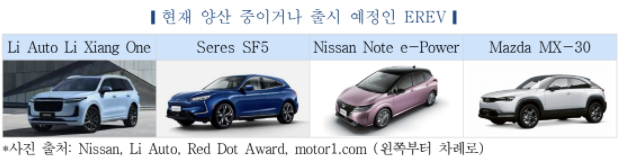
However, recently, automakers in China and Japan have shown renewed interest in EREVs. In China, Li Auto sells EREVs instead of electric vehicles, and Seres, in partnership with IT company Huawei, launched the SF5 sports utility vehicle (SUV) as an EREV.
Among Japanese companies, Nissan unveiled the second-generation e-Power, a series hybrid system similar to EREV, declaring it as one of the two pillars for expanding eco-friendly vehicles alongside electric vehicles. Mazda is also planning to launch an EREV equipped with a range-extending rotary engine on its electric MX-30.
EREVs have the advantage of combining the strengths of both internal combustion engine vehicles and electric vehicles (BEV). They offer the acceleration and smooth driving experience unique to electric vehicles, while the engine used for battery charging operates at nearly constant speed and load, achieving high thermal efficiency.
Unlike electric vehicles, whose driving range is limited by the battery capacity per charge, EREVs continuously charge the battery while driving, enabling a driving range comparable to internal combustion engine vehicles. For example, the SF5 by Seres can travel up to 1000 km on the NEDC standard when both the battery and fuel tank are fully charged.
There is also a significant cost advantage. Typical EREVs combine a smaller drive battery of around 30-40 kWh with a small engine, resulting in lower manufacturing costs compared to electric vehicles of the same class.
The renewed attention on EREVs is because they can be an attractive option in countries with insufficient charging infrastructure, where fossil fuel prices are low and the benefits of electric vehicle adoption are limited, or among consumer groups who cannot afford electric vehicles.
Considering these points, the Korea Automotive Research Institute advised that our policy authorities should also establish a diverse policy portfolio for eco-friendly vehicles. The institute stated, "Many companies are currently exploring various approaches, including EREVs, to make vehicles more eco-friendly. Policy authorities need to recognize that electric vehicles are not the only solution," adding, "Especially since there is a possibility of delays in reducing carbon emissions in power generation and parts manufacturing, which are prerequisites for electric vehicles to have an environmental advantage, a policy portfolio for eco-friendly vehicles considering various scenarios is necessary."
© The Asia Business Daily(www.asiae.co.kr). All rights reserved.

















