Global Floating Offshore Wind New Power Capacity... 75MW in 2020 → Expected 2000MW in 2030
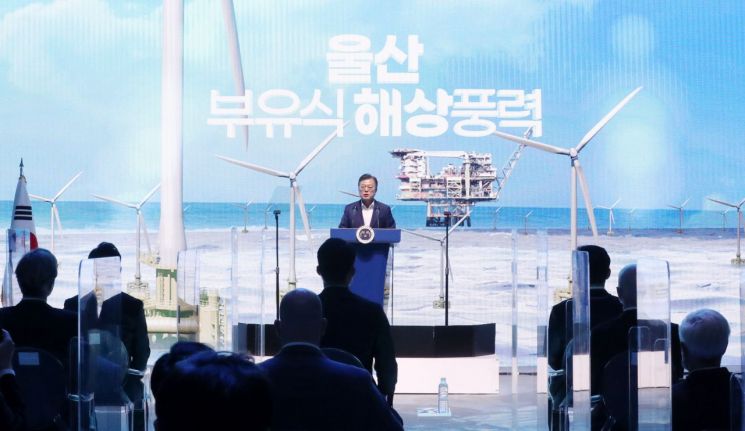
[Sejong=Asia Economy Reporter Kwon Haeyoung] The global floating offshore wind power capacity is expected to grow to 2,000 MW annually by 2030. The South Korean government also plans to promote floating offshore wind power to accelerate the energy transition and achieve carbon neutrality by 2050.
According to the Global Wind Energy Council (GWEC) on the 8th, the global floating offshore wind market's new capacity is projected to expand from 75 MW in 2020 to 2,000 MW by 2030.
Floating offshore wind power is a technology that installs turbines on floating structures, unlike fixed offshore wind power which installs foundations on the seabed. Its drawbacks include higher operating and grid connection costs compared to fixed offshore wind power. However, it can be installed in far offshore locations, reducing offshore work periods and shortening construction time. Once economic feasibility is secured, it is expected to complement the disadvantages of fixed offshore wind power, which can spoil coastal scenery and infringe on fishermen's fishing rights when installed near the shore.
The government plans to activate the deployment of both fixed and floating offshore wind power to achieve the 'Renewable Energy 3020' goal of expanding the renewable energy generation share to 20% by 2030.
As of December 2020, the domestic wind power capacity stands at 1,677 MW. Onshore wind power accounts for most of it with 1,535 MW, while offshore wind power is 142 MW, making up only 8.5% of the total wind power market. However, to implement the Renewable Energy 3020 plan, 12 GW of offshore wind power must be deployed by 2030. The government has set a target to deploy 48.78 GW of renewable energy by 2030, including 16.5 GW of wind power (12 GW offshore and 4.5 GW onshore).
As part of this energy transition policy, Ulsan City plans to build a floating offshore wind power plant near the Ulsan offshore Donghae gas field by 2030. The power generation target is 6 GW. If the government grants power generation permits next year, a total project cost of 36 trillion won will be invested from 2023 to 2030.
Additionally, the government will strengthen support for research and development (R&D) of floating offshore wind power. Recent trends in wind power technology among leading overseas companies focus on ultra-large turbines of 10 MW or more, floating structures, and long-term lifespan technologies exceeding 40 years. Domestic technology currently lags behind overseas. The government plans to secure competitiveness through localization of core components and promotion of ultra-large and floating R&D.
© The Asia Business Daily(www.asiae.co.kr). All rights reserved.

















