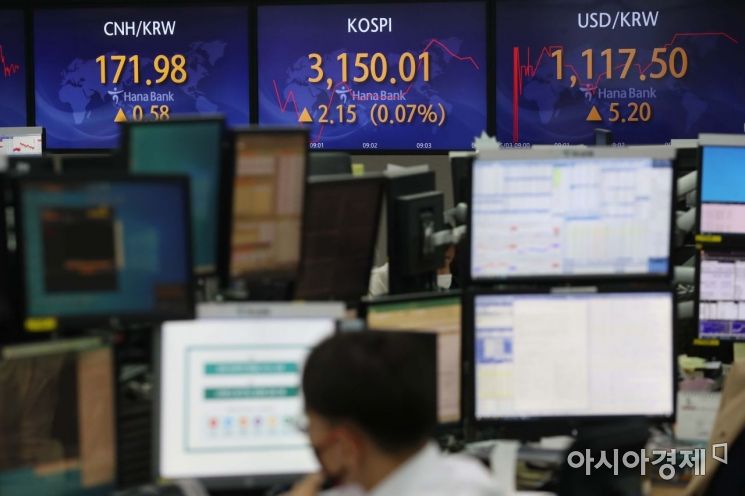
 On the first day of the partial resumption of short selling on the 3rd, the KOSPI index is displayed on the electronic board in the dealing room of Hana Bank in Euljiro, Seoul. Photo by Mun Ho-nam munonam@
[Asia Economy Reporter Junho Hwang] Investors are focusing their attention ahead of this month's announcement of changes to the Korea Exchange's stock indices. Interest centers on the index effect of newly included stocks and the exclusion effect from short-selling restrictions on removed stocks.
On the 8th, NH Investment & Securities Research Center identified Hyosung TNC, Hyosung Advanced Materials, Daehan Electric Wire, Dongwon Industries, and SK Bioscience as stocks expected to benefit from favorable supply-demand effects related to the KRX index changes announced this month and implemented from next month, particularly concerning the KOSPI200.
The Exchange changes the stock index components twice a year, in June and December. Accordingly, passive funds tracking the Exchange indices will replace their constituent stocks on the simultaneous futures and options expiration date on the 10th of next month. Stocks newly included in indices such as KOSPI200 and KOSDAQ150 can expect favorable supply-demand effects. Conversely, it is necessary to adopt a strategy to reduce weights in stocks expected to be excluded from the indices in advance.
Among the stocks expected to be included, NH Investment & Securities anticipates that Hyosung TNC, which has the largest free-float market capitalization (market cap adjusted for free float), will generate approximately 81.3 billion KRW in passive buying demand. Meanwhile, Dongwon Industries is expected to have a relatively smaller passive buying demand of 13.4 billion KRW, but due to its low average daily trading volume, the effect could be even greater.
Stocks expected to be excluded from the KOSPI200 include Namseon Aluminum, Binggrae, Taeyoung Construction, and Samyang Corporation. Among these, Namseon Aluminum, which has the largest free-float market capitalization, is projected to face about 16.9 billion KRW in passive selling pressure. On the other hand, Binggrae is expected to show the clearest index effect among the excluded stocks due to its small average daily trading volume relative to the 15.2 billion KRW passive selling demand.
However, due to the high level of interest related to the index changes, the index effect may appear weaker than expected. Investors sensitive to regular changes tend to preemptively reflect stock changes in their portfolios. To confirm the pre-reflection of the index effect, one can refer to the net buying volume of institutional investors (excluding financial investment firms) for the stocks expected to be included or excluded.
Another point investors should pay attention to ahead of this index change is short selling. Researcher Donggil Noh of NH Investment & Securities Research Center pointed out, "Since the short-selling ban was lifted in March last year, short covering (liquidation of short positions) has been observed commonly in both KOSPI200 and KOSDAQ150 stocks," adding, "Changes in short-selling eligibility due to index component changes will further clarify the index effect." He further assessed, "Stocks excluded from the index can expect positive supply-demand effects from short covering after the rebalancing date."
© The Asia Business Daily(www.asiae.co.kr). All rights reserved.
![Clutching a Stolen Dior Bag, Saying "I Hate Being Poor but Real"... The Grotesque Con of a "Human Knockoff" [Slate]](https://cwcontent.asiae.co.kr/asiaresize/183/2026021902243444107_1771435474.jpg)











