Household Debt and Economic Recovery Both Needed... Yellen's 'Surprise Statement'
Risk of Loan Defaults Centered on Vulnerable Borrowers Amid Interest Rate Hikes
[Asia Economy Reporter Jang Sehee] As early interest rate hike signals from the U.S. and inflation concerns arise, there is a forecast that discussions on interest rate hikes will accelerate in South Korea as well. The Bank of Korea is also facing a dilemma over whether to raise interest rates to curb the increase in household debt or to maintain a low interest rate policy to support economic recovery.
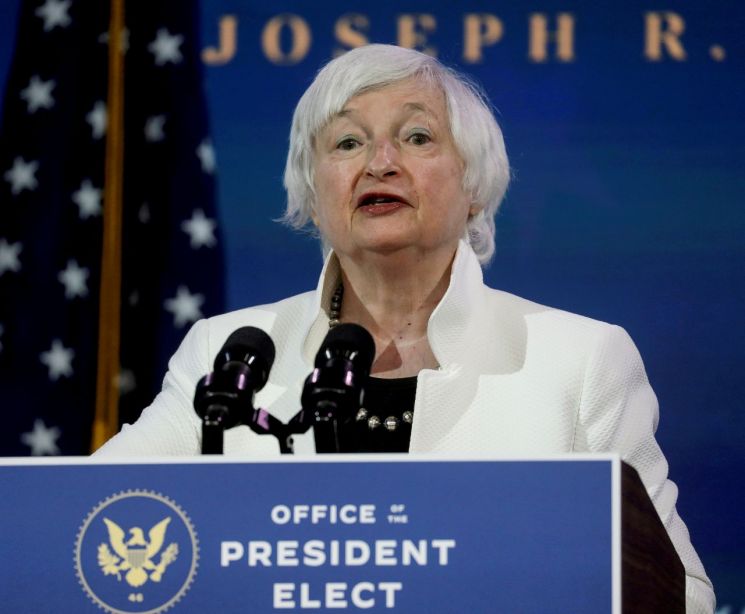
According to the financial sector on the 8th, remarks by U.S. Treasury Secretary Janet Yellen on interest rate hikes are expected to influence the decision on domestic interest rate hikes. Secretary Yellen previously stated in a pre-recorded speech at a virtual conference hosted by the economic magazine The Atlantic, "We may need to raise interest rates somewhat to prevent the economy from overheating." She added, "There could be a very gradual interest rate increase due to asset reallocation."
Following the U.S. moves, there is a growing atmosphere in the domestic financial market advocating for early interest rate hikes. This is due to rapid household debt growth and excessive liquidity raising inflation concerns.
In fact, looking at the loan and deposit balances of KB Kookmin, Shinhan, Hana, Woori, and NH Nonghyup banks, as of the end of April, household loan balances stood at 690.8623 trillion won, an increase of 1.4% (9.2266 trillion won) compared to the previous month.
The monthly household loan growth rate (compared to the previous month) had been low at 0.5% in December, 0.6% in January and February, and 0.5% in March after recording 1.4% in November last year, but it rose sharply again last month.
However, some warn that raising interest rates without giving sufficient signals to the market could increase the burden of principal and interest repayments in the future.
Due to the increase in loans, loan interest rates are also on the rise. According to the 'March Financial Institution Weighted Average Interest Rate' announced by the Bank of Korea on the 30th of last month, the weighted average interest rate on new household loans from deposit banks rose by 0.07 percentage points from 2.81% in February to 2.88% in March.
Professor Kim Sangbong of the Department of Economics at Hansung University said, "If interest rates rise, there is a risk of some defaults, especially among vulnerable borrowers," and added, "It is necessary to prepare safety measures such as for low-income finance."
He also said, "The policy interest rate is already lagging behind the market interest rate," and predicted, "Considering vaccine rollouts and the pace of economic recovery, it is necessary to consider raising interest rates in November."
© The Asia Business Daily(www.asiae.co.kr). All rights reserved.

















