China Declares Suspension of 'Strategic Economic Dialogue'... Retaliation Over Australia's Belt and Road Project Cancellation
New Zealand Mentioned as Alternative to Australia, but New Zealand Is Also a Five Eyes Member
[Asia Economy Beijing=Special Correspondent Jo Young-shin] China has announced the suspension of the "Strategic Economic Dialogue" with Australia. This is a retaliatory measure following the Australian federal government's termination of the Belt and Road Initiative (land and maritime Silk Road) Memorandum of Understanding (MOU). There are evaluations that the two countries have effectively crossed the Rubicon River.
According to Chinese media including Xinhua News Agency on the 7th, the National Development and Reform Commission (NDRC) of China indefinitely suspended the bilateral Strategic Economic Dialogue with the Australian government held the previous day. The NDRC explained the suspension was due to the Australian government's ideological prejudice damaging bilateral exchanges and cooperation.
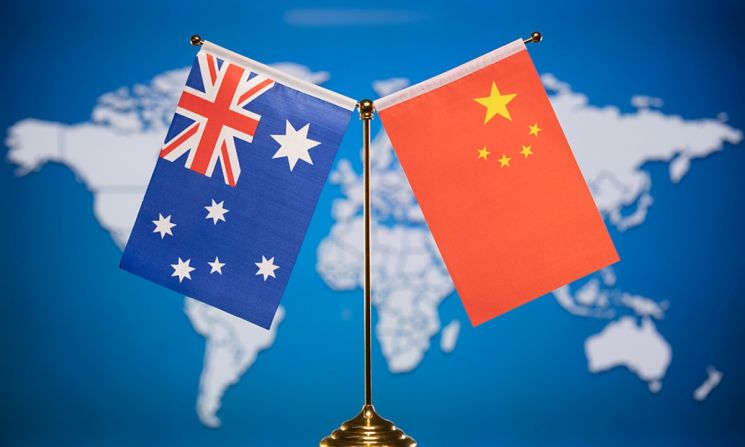
The Global Times assessed this as a substantial and resolute response from China to Australia's unilateral termination of the Belt and Road Initiative project, and a strong political message from the Chinese government to the Australian government. Citing experts, the media warned that this move signifies a rupture rather than a deadlock in bilateral relations and that trade between the two countries will sharply decline.
Zhou Fangyin, a professor at the School of International Relations at Guangdong University, said, "This move is very rare in China's diplomatic practice," adding, "It shows China's firm will towards Australia and that China is prepared to mobilize all possible means."
The Chinese Ministry of Foreign Affairs also stated that this measure is a necessary and justified response, placing all responsibility on Australia.
Given that the deterioration of bilateral relations is not beneficial even from China's perspective, the possibility of behind-the-scenes contact between the two countries cannot be ruled out. Last year, China's imports from Australia reached 145.2 billion Australian dollars (approximately 127 trillion Korean won). Although imports decreased by 2.15% compared to the previous year amid escalating conflicts, the scale of trade remains large. China mainly imports energy resources such as iron ore and coal, as well as agricultural and livestock products like wheat and barley.
The Global Times reported that New Zealand is emerging as an alternative import source for Australia, but the reality is that China is facing supply-demand imbalances in the energy and agricultural sectors.
Moreover, New Zealand is also a member of the Five Eyes alliance (United States, United Kingdom, Canada, Australia, New Zealand) and shares a unified stance on the Xinjiang Uyghur human rights issue, leading to criticisms that it is unlikely to become a substitute for Australia.
Meanwhile, Chinese Premier Li Keqiang emphasized the importance of food security at a State Council meeting held the previous day and instructed to actively promote the modernization of rural areas.
© The Asia Business Daily(www.asiae.co.kr). All rights reserved.
![Clutching a Stolen Dior Bag, Saying "I Hate Being Poor but Real"... The Grotesque Con of a "Human Knockoff" [Slate]](https://cwcontent.asiae.co.kr/asiaresize/183/2026021902243444107_1771435474.jpg)
















