It is the era of big data. Meaningful facts can be derived through data analysis.
By analyzing Seoul's living population data, it is possible to know where Seoul citizens stay. Seoul's living population data is population data estimated by Seoul City and KT using public big data and communication data, representing the population present in specific areas of Seoul at specific times.
By analyzing the population staying over time, trends can be derived on where people sleep (residence) and where they work (workplace). Generally, by analyzing the population staying between 3 AM and 5 AM and between 1 PM and 4 PM, it is possible to compare the sleeping population with the working and living population.
The greater the difference in living population between the early morning and daytime (sleeping people and working people), the more commuters moving from other areas there are. Such areas can be considered to have high demand for proximity between residence and workplace. The area around Gasan-dong, Guro-gu in Seoul is such a place.
According to Seoul living population data calculated as the average for each hour of the day throughout 2020, the number of people staying in Seoul between 3 AM and 4 AM is at its lowest, 10.35 million. Between 3 PM and 4 PM, the highest number of about 10.76 million people stay. It can be seen that the daytime active population is about 4% higher than the sleeping population in Seoul.
Seoul Digital Industrial Complex G-Valley, Day-Night Population Difference 2.46 Times
Analyzing Seoul Digital Industrial Complex G-Valley (located in Gasan-dong and Guro 3-dong), the only national industrial complex in Seoul, shows that between 3 AM and 4 AM, at least 60,000 people stay, and between 1 PM and 2 PM, up to 147,000 people stay. The number of people living during the day is about 146% higher than those sleeping. Arithmetically, this means that 87,000 more residential spaces are needed.
G-Valley is Seoul's only national industrial complex, and recently, with companies like Netmarble headquarters moving in, IT and venture companies have gathered, causing a rapid increase in demand for single-person household spaces among young office workers.
In Seoul, where ultra-small residential spaces are lacking, knowledge industry center dormitories are being supplied and gaining attention as residential spaces for single-person households.
The 'Gasan Mobius Tower Coliving House (Dormitory)' that has just started supply in G-Valley, Seoul's only national industrial complex, is exactly such a place.
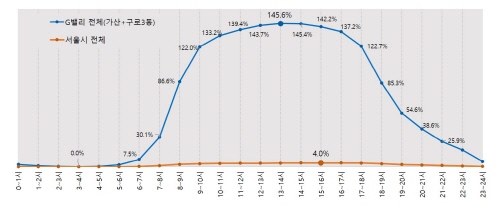 [Seoul City and G-Valley's Analysis of Resident Population by Time Slot Based on 3-4 AM / Basic Data Source: Seoul Open Data Plaza Seoul Resident Population]
G-Valley ‘Gasan Mobius Tower Coliving House (Dormitory)’ Gains Attention as Ultra-Small Residential Space
Fides Development has officially started supplying 391 units of the ‘Gasan Mobius Tower Coliving House (Dormitory)’.
The Gasan Mobius Tower Coliving House has a ceiling height raised to 3.35m?3.72m, higher than the typical apartment ceiling height of 2.3m, and applies loft-style mezzanines (applied to 382 units) to utilize space three-dimensionally.
For quarantine and safe access and security management, air shower booths, elevator sterilization systems, and touchless biometric access systems are installed. Bathroom vertical piping and independent direct ventilation systems are applied to prevent the spread of viruses or contaminants inside, creating a ‘Safe & Smart’ space.
The space is designed as a ‘We Do’ area where everyone can use the space with a good view, including a rooftop terrace on the top floor and pocket lounges on five floors. Shared kitchen, dining lounge, fitness center, laundry room, rooftop garden, and the top floor lounge are designed to be used as coworking spaces such as meeting rooms, book cafes, workrooms, and studios.
From the project planning stage, through a proptech collaboration project, the professional operation management system of Zigbang affiliate Share House Uju is applied, guaranteeing and managing profits for up to 8 years.
A real estate expert said, “The demand for proximity between residence and workplace among the MZ generation will continue to increase. Residential demand for young MZ generation office workers living alone or in two-person households is expected to continuously grow, especially in areas with concentrated jobs and large day-night population differences.”
© The Asia Business Daily(www.asiae.co.kr). All rights reserved.

















