Expectations of Deregulation Stimulate Seoul Housing Prices
Rising House Prices Lead to Larger Increase in Jeonse Prices
Comprehensive Real Estate Tax Imposed Next Month, Jeonse and Monthly Rent Reporting System Implemented
Experts Say "Jeonse Prices May Rise in the Second Half of the Year"
[Asia Economy Reporters Moon Jae-won and Ryu Tae-min] As prices for land plots have started to rise around major reconstruction apartment complexes in Seoul, a slight rebound is being detected in the previously stabilizing jeonse (long-term lease) prices. All four Gangnam districts saw an expansion in the rate of increase in jeonse prices this week, and the index reflecting Seoul’s jeonse supply-demand situation turned upward after a week. Concerns are being raised that the jeonse market, which had slowed down recently due to fatigue from last year’s sharp rise, could become unstable again in the second half of the year.
According to the real estate industry on the 7th, jeonse prices have been fluctuating in various parts of Seoul recently. Looking at statistics from the Korea Real Estate Board, Seoul apartment jeonse prices rose by 0.03% this week, an increase from 0.02% the previous week. Although this is moderate compared to the 0.1% range increase that continued until early this year, the fact that the rate of increase has grown for the first time in about six months since November last year suggests that the stability has weakened.
Since the inauguration of Seoul Mayor Oh Se-hoon, expectations of deregulation have caused land prices in reconstruction-promoting complexes to rise significantly, which is interpreted as having influenced jeonse prices as well. In fact, Nowon-gu, considered the biggest beneficiary of Mayor Oh’s election, recorded the highest land price increase rate (0.21%) and jeonse price increase rate (0.10%) in Seoul. A Korea Real Estate Board official explained, "Jeonse prices in Nowon-gu rose mainly due to reconstruction in Sanggye-dong."
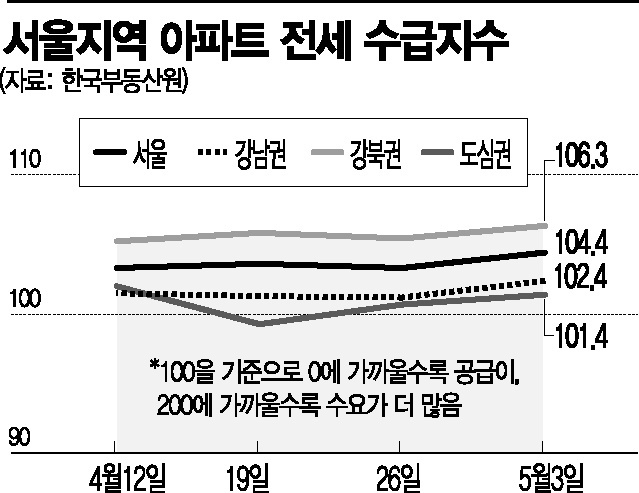
The Gangnam area, where high-priced reconstruction complexes are concentrated, shows a similar trend. Jeonse prices for apartments in Seocho-gu, Songpa-gu, and Gangdong-gu, which were flat until last week, rose by 0.01%, 0.02%, and 0.01% respectively this week, while Gangnam-gu, which recorded a 0.01% increase last week, shifted to a flat trend this week. According to the real estate information platform Asil, jeonse listings decreased in 18 out of 25 districts in Seoul compared to a week ago. The Korea Real Estate Board’s jeonse supply-demand index also rebounded from 103.3 last week to 104.4 this week, indicating that demand has increased relative to supply.
The problem is that jeonse prices are likely to rise further. The jeonse and wolse (monthly rent) reporting system, the last piece of the ‘Lease 3 Act,’ will be fully implemented in June, and once the comprehensive real estate tax is confirmed, landlords may raise jeonse prices to offset tax burdens. Especially for the comprehensive real estate tax, a significant increase compared to previous years is expected this year as well, raising concerns about tax pass-through.
Professor Cho Joo-hyun of Konkuk University’s Department of Real Estate said, "Due to the introduction of the Lease 3 Act, the burden of contract renewals and rent caps has increased, so jeonse prices will rise further," adding, "Low interest rates are also a cause."
The government expects that if the supply of public jeonse increases, landlords will find it difficult to raise jeonse prices easily, but the market views this effect as limited. The Ministry of Land, Infrastructure and Transport announced plans to supply a total of 80,000 households by next year through new construction purchase agreements and public jeonse, but many of these are multi-family types rather than apartments, making it difficult to meet the increasing jeonse demand. Moreover, it is uncertain how much public rental housing will attract market interest in terms of location.
The upcoming large-scale relocation in Gangnam reconstruction complexes also burdens the jeonse market. About 4,000 households in Seocho-gu’s Banpo Jugong Complex 1, 2, and 4 districts, Shinbanpo 18th and 21st complexes, and Banpo Jugong Complex 1 district 3 are preparing for relocation due to reconstruction in the second half of the year. Once relocation begins in earnest, jeonse demand may flow not only to Seocho-gu but also to nearby areas such as Dongjak-gu and Gyeonggi-do, raising concerns about a rapid rise in jeonse prices in a short period. However, the number of apartment move-ins in Seoul this second half is only about half of last year’s level.
Professor Seo Jin-hyung of Gyeongin Women’s University (President of the Korean Real Estate Society) also said, "When lease renewal contracts expire due to the Lease 3 Act, a surge in jeonse prices will occur," adding, "Public jeonse accounts for only 8% of rental housing, so it is difficult to have a significant impact on the market."
© The Asia Business Daily(www.asiae.co.kr). All rights reserved.

















