Merkel Opposes Biden's Announcement Immediately
"Intellectual Property Protection is the Source of Innovation"
US-Germany Conflict Complicates EU Discussions
Even if Released, Production and Development Take Years
Hong Nam-gi: "Financial Support for Domestic Vaccines is Essential"
[Asia Economy reporters Seo So-jung and Cho Hyun-ui] Germany has officially expressed opposition to the temporary waiver of intellectual property rights (IPR) for COVID-19 vaccines supported by the United States. The IPR waiver discussions, which had gained momentum despite Germany’s resistance as the home of messenger RNA (mRNA) COVID-19 vaccine manufacturers and a leading voice in European Union (EU) public opinion, have now encountered obstacles.
◆Germany: "IPR Protection is the Source of Innovation"= According to foreign media, a spokesperson for the German government stated on the 6th (local time) regarding the temporary waiver of COVID-19 vaccine IPR, "We support the goal of supplying COVID-19 vaccines worldwide, but the constraints on vaccine production are not patents but production capacity and quality standards." The spokesperson added, "IPR protection is the source of innovation," emphasizing, "It must remain so in the future."
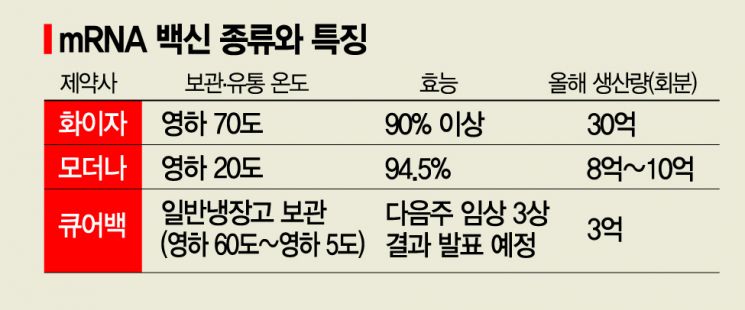
Germany is home to BioNTech, a domestic pharmaceutical company that developed the mRNA vaccine jointly with Pfizer. Additionally, Germany is preparing to launch the third mRNA vaccine following Pfizer and Moderna. As early as next week, German pharmaceutical company CureVac is expected to announce the results of its Phase 3 clinical trials for its mRNA COVID-19 vaccine. Over 37,000 volunteers from Europe and Latin America participated in CureVac’s clinical trials. Franz-Werner Haas, CEO of CureVac, said in a media interview, "Cases demonstrating vaccination effectiveness are emerging rapidly."
Notably, CureVac’s mRNA vaccine can be stored and distributed in a regular refrigerator, emerging as a new ‘game changer.’ Like Pfizer and Moderna vaccines, CureVac’s vaccine requires two doses. However, it offers significant logistical advantages. Pfizer and Moderna vaccines must be stored at ultra-low temperatures of around minus 70 degrees and minus 20 degrees Celsius, respectively, making storage conditions challenging. In contrast, CureVac’s vaccine maintains efficacy for up to three months in standard refrigeration facilities, which is considered a major advantage.
Professor Cheon Eun-mi of the Department of Respiratory Medicine at Ewha Womans University Mokdong Hospital said, "If the Phase 3 clinical results are favorable, South Korea should actively consider introducing the CureVac vaccine." CureVac has already applied for approval in the EU and signed supply contracts for 450 million doses with EU countries. Among these, 180 million doses are conditional. CureVac plans to produce 300 million doses this year and up to 1 billion doses next year.
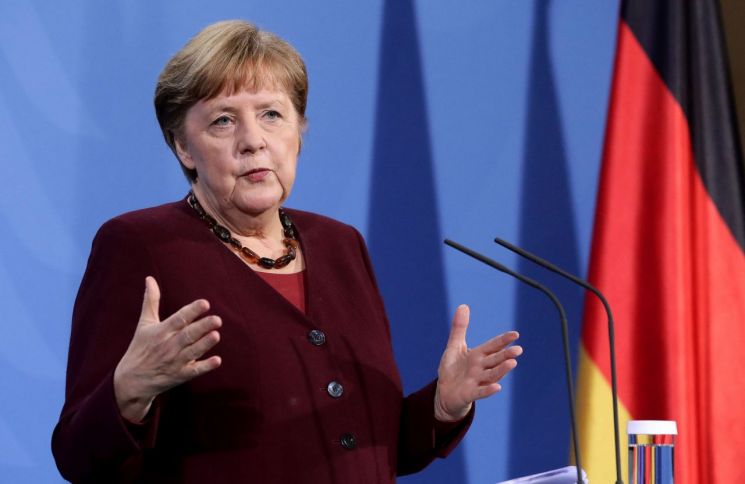
◆US and Germany Face Difficulties in IPR Waiver Discussions= As the US and Germany clash over the IPR waiver, discussions on the waiver are expected to face difficulties. The British daily The Guardian evaluated that Germany’s opposition to the vaccine IPR waiver has revealed the first serious rift between the two countries since the Biden administration took office.
Earlier that day, EU Commission President Ursula von der Leyen stated that the EU is ready to discuss the IPR waiver, but Germany’s opposition has posed a challenge. Coordination of positions within the EU is also difficult. France and Italy have expressed strong support for the IPR waiver. Spain said, "The IPR waiver is appropriate," but also noted that it does not guarantee vaccine supply to developing countries. The EU will address the IPR issue as an agenda item during a two-day meeting this week. For the vaccine IPR waiver to be approved, all 164 World Trade Organization (WTO) member countries must agree.
South Korea’s bio and pharmaceutical industries are also closely watching the direction of the IPR waiver discussions. While the possibility of manufacturing and supply opportunities is positive, there is a cautious atmosphere due to many hurdles in resolving IPR issues. An SK Bioscience official said, "Even if IPR is disclosed, it takes two years to build a vaccine factory, one year to produce prototypes, and four to ten months for technology transfer and process development," adding, "Without active technical support from the provider company, it is impossible."
Another bio industry official said, "This may be a high-level strategy by the US government, which faces criticism for not exporting vaccines," and predicted, "If pharmaceutical companies like Pfizer refuse, there is no enforcement authority, and opposition from Germany and others will require months of time and coordination procedures, so it will take longer than expected."
Meanwhile, Hong Nam-ki, Acting Prime Minister, said at the COVID-19 vaccine and treatment status meeting that "Strong financial support is essential not only to encourage domestic vaccine development but also to establish a foundation for becoming a vaccine hub country," adding, "A task force (TF) composed of several related ministries, led by the Ministry of Strategy and Finance, is currently operating to discover related budget projects and reflect necessary expenses for 2022."
Hong also said, "Two companies have announced that they can enter Phase 3 clinical trials in the second half of the year and are requesting support for comparative clinical trials similar to overseas cases," adding, "We plan to prepare guidelines by June to provide customized support for companies."
© The Asia Business Daily(www.asiae.co.kr). All rights reserved.


















