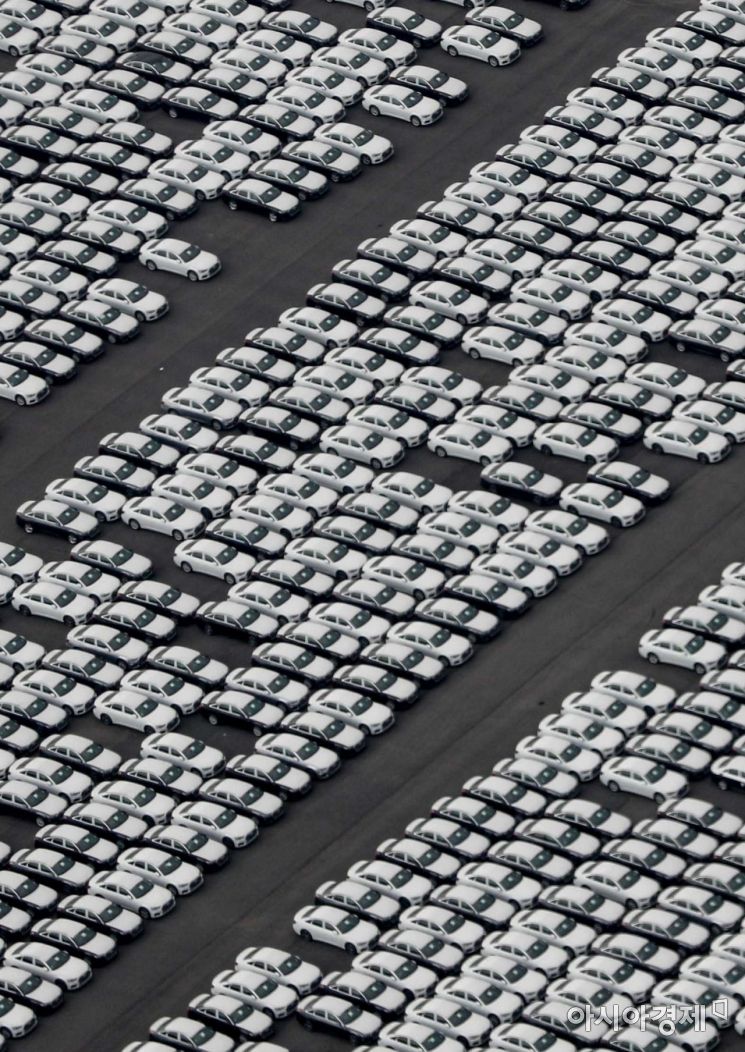
 Imported cars are waiting to be shipped at Pyeongtaek Port, as seen from a Seoul Metropolitan Police Agency helicopter on the 10th, one day before the Lunar New Year holiday./Photo by Jinhyung Kang aymsdream@
[Asia Economy Reporter Yu Je-hoon] The domestic completed car industry is preparing to enter the summer labor dispute (夏鬪) season by formulating wage and collective bargaining demands for this year. Unlike last year, when the unprecedented COVID-19 pandemic led to a decision to 'freeze wages,' this year presents numerous challenges such as wage and performance bonus increases and preparations for the future car era, making it widely expected that reaching an agreement between labor and management will not be easy.
According to the industry on the 7th, the Hyundai Motor and Kia branches of the Korean Metal Workers' Union under the Korean Confederation of Trade Unions will hold a temporary delegates' meeting next week to finalize this year's wage and collective bargaining demands. Subsequently, each union is expected to hold a preliminary meeting with management as early as the end of this month or the beginning of next month and begin full-scale wage and collective bargaining negotiations.
Last year, most domestic completed car unions agreed to freeze wages. This was based on the need for shared sacrifice as the COVID-19 situation spread worldwide from the beginning of the year. Ssangyong Motor, which faced a survival crisis after the withdrawal of major shareholder Mahindra, was the first to take action in April last year, followed by Hyundai Motor labor and management agreeing to freeze base wages for the first time in 11 years. Kia and Korea GM also experienced ups and downs such as strikes but ultimately agreed on wage freezes.
However, expectations are growing that this year's wage and collective bargaining negotiations will differ from last year's situation. With vaccine distribution leading to a rapid recovery in automobile consumption in major countries and a surge in sales, as well as a compensatory sentiment due to last year's wage freeze, this can be seen as a kind of 'COVID-19 bill.'
In fact, the Korea GM branch held a temporary delegates' meeting on the 26th of last month and finalized demands for this year's wage negotiations, including a base wage increase of 99,000 KRW, a performance bonus of 150% of the ordinary wage, and a 4 million KRW encouragement bonus. This base wage increase demand matches the proposal put forward by the Metal Workers' Union (99,000 KRW). Kia is also reported to have prepared a draft including a base wage increase of 99,000 KRW and a performance bonus payment of 30% of annual operating profit.
Hyundai Motor is also likely to present a demand at a similar level. A Hyundai Motor branch official stated, "The long-standing basic principle is to allocate profits 30% to shareholders, 30% to workers, and 40% to reinvestment for the future," adding, "This year's wage and collective bargaining will focus on three main tasks: wages and performance bonuses, extension of retirement age linked to national pension, and employment stability in the future car era."
Additionally, employment stability in the future car era is expected to emerge as a key topic. The Korea GM branch is said to demand new car allocations and electric vehicle production at the Bupyeong 2 plant, which has no assigned volume after July next year, while the Hyundai Motor branch plans to continue special negotiations related to production facilities in new industrial fields such as Urban Air Mobility (UAM) and robotics.
The problem is that the situation for the completed car industry receiving these demands is not easy. In particular, the concerns of the three foreign completed car companies are greater. All three foreign companies posted losses last year due to a sharp decline in sales, and their sales performance this year has not been promising. The combined sales volume of the three foreign completed car companies last month (including domestic and export) was 35,180 units, down about 27% compared to the previous year.
Korea GM, which posted a consolidated loss of 309.2 billion KRW last year alone, has been operating under a reduced production system since February due to the global shortage of automotive semiconductors. Recently, even the Bupyeong 1 plant, which produces the best-selling Trailblazer model, has reduced its operating rate by half.
Renault Samsung is in an even more serious situation. It has yet to conclude last year's wage and collective bargaining agreement. Recently, conflicts have escalated due to the closure of maintenance service centers, with the Renault Samsung union conducting an indefinite full strike and management implementing partial workplace closures, resulting in a standoff. Although the proportion of union members participating in the strike remains around 25%, production disruptions caused by this are inevitable. Reporter Yu Je-hoon kalamal@
© The Asia Business Daily(www.asiae.co.kr). All rights reserved.

















