"Upkwon Act Must Be Enacted" vs. "Existing Laws Are Sufficient": Diverging Methodologies
Market Anticipates Institutional Inclusion
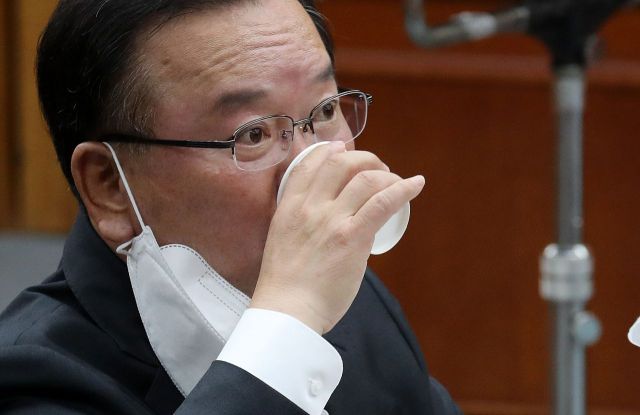 Prime Minister nominee Kim Boo-kyum appeared at the confirmation hearing held at the National Assembly on the 6th, drinking water as if feeling anxious. Photo by Yoon Dong-joo doso7@
[Asia Economy Reporter Gong Byung-sun] As Prime Minister nominee Kim Boo-kyum mentioned the necessity of institutionalizing the cryptocurrency market, opinions on the methodology of institutionalization are divided. The industry argues that a cryptocurrency-specific law is necessary, while academia says that existing laws are sufficient for institutionalization.
On the 6th, during the parliamentary confirmation hearing, nominee Kim said, "The government's concern is that more than 4 million people are trading in the cryptocurrency market," adding, "It was irresponsible of the government to say 'handle it yourself' just because they didn't know well." This stance is completely opposite to that of Eun Sung-soo, Chairman of the Financial Services Commission, who believes that institutionalization and investor protection in the cryptocurrency market are unnecessary.
As a result, expectations are growing that the cryptocurrency market may soon be incorporated into the regulatory framework. Until now, the industry has argued that institutionalization is necessary to foster blockchain businesses and protect investors. An industry official said, "The industry has been striving for industrial growth through self-regulation, but felt limitations due to the lack of clear systems and regulations," adding, "If institutionalization proceeds as nominee Kim suggested, the market will become more transparent and grow further."
However, opinions differ on the method. While the industry insists on the need for a cryptocurrency-specific law, academia believes that existing laws can sufficiently protect investors.
The industry emphasized that a cryptocurrency-specific law must be enacted to lay the foundation of the cryptocurrency market. Since blockchain is a decentralized technology that breaks away from the previously centralized governance structure, a new system is necessary. Lawyer Park Jong-baek (Law Firm Taepyungyang) said, "There is no definition of cryptocurrency yet, nor are there requirements such as reporting or registration," adding, "To protect investors, the cryptocurrency-specific law will define cryptocurrencies and include standards and contents to resolve disputes step-by-step."
However, academia explained that a cryptocurrency-specific law could give preferential treatment to the cryptocurrency market. Since the details are still unclear, if conflicts of interest arise, it may fail to impose regulations equivalent to those in the capital market. Professor Hong Ki-hoon of Hongik University’s Department of Business Administration argued, "Just as the amendment to the Act on Reporting and Using Specified Financial Transaction Information prevents money laundering, amending the currently enacted laws is sufficient to regulate cryptocurrencies," adding, "A cryptocurrency-specific law could place the cryptocurrency market in an ambiguous position." Furthermore, he said, "To prevent this from becoming a political issue, the government should take the lead in institutionalizing cryptocurrencies rather than the National Assembly."
© The Asia Business Daily(www.asiae.co.kr). All rights reserved.
![Clutching a Stolen Dior Bag, Saying "I Hate Being Poor but Real"... The Grotesque Con of a "Human Knockoff" [Slate]](https://cwcontent.asiae.co.kr/asiaresize/183/2026021902243444107_1771435474.jpg)











