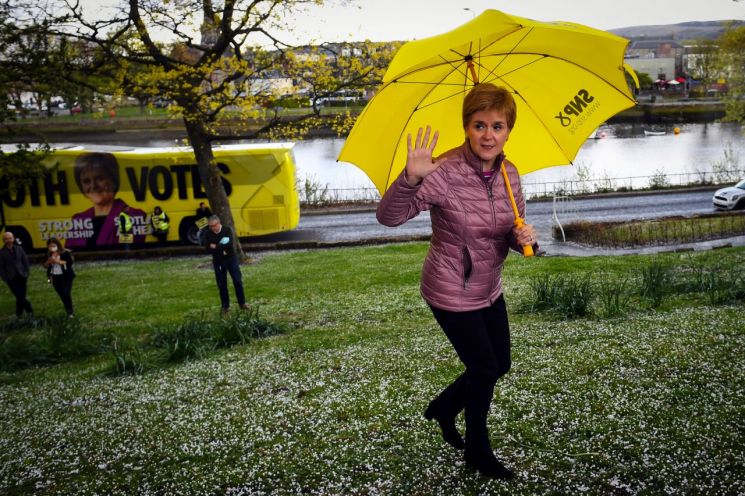
 Nicola Sturgeon, leader of the Scottish National Party (SNP) and head of the Scottish Government
 [Photo by Reuters]
[Asia Economy Reporter Park Byung-hee] Scotland is holding parliamentary elections on the 6th (local time). While the Scottish National Party (SNP) is expected to secure an overwhelming majority as the largest party in the parliament, the focus is on whether the SNP can achieve an absolute majority. The SNP has announced that if it secures a majority of seats, it will hold a second referendum on Scottish independence.
According to major foreign media on the 5th, polls predict that the SNP will secure close to a majority of seats.
Polling firm Savanta/ComRes forecasted that the SNP would secure seats just 6 short of a majority out of the total 129 seats. Another polling firm, Ipsos MORI, stated that while it is certain the SNP will be the dominant party in parliament, whether it will achieve a majority remains uncertain.
Attention is also on how many seats the Green Party, which supports independence from the United Kingdom along with the SNP, will secure. The Green Party has cooperated with the SNP in passing legislation and has shown openness to forming a coalition government depending on the election results.
The SNP has declared that if it secures a majority in the parliamentary election, it will accept the demand for independence and push forward with a second independence referendum.
The SNP secured a majority only once in the 2011 election, and with the consent of then UK Prime Minister David Cameron, held a referendum in 2014 asking whether to agree to independence. The vote resulted in 55% opposing independence and 45% supporting it, thus independence was rejected.
However, support for Scottish independence has increased following the United Kingdom's withdrawal from the European Union (Brexit). The UK decided on Brexit through a referendum in 2016. The referendum results were 52% in favor of Brexit and 48% against. At that time, England and Wales supported leaving, while Scotland and Northern Ireland opposed it.
Additionally, positive evaluations of SNP leader Nicola Sturgeon's response to COVID-19, along with growing resentment toward the UK government under Boris Johnson, have fueled pro-independence sentiment.
UK Prime Minister Boris Johnson has stated that he will not allow a second Scottish independence referendum. Sturgeon has said that while she will not hold an illegal referendum that Johnson does not permit, she will take legal action against Johnson for refusing to allow the referendum.
© The Asia Business Daily(www.asiae.co.kr). All rights reserved.

















