Administration of Seontoe (蟬退, Maemihumul) Extract in Experimental Animals Reduces Itching Symptoms by Half
Confirmed Mechanism of Action Regulating Inflammatory Substances by Inhibiting Activation of NLRP3 Inflammasome
[Asia Economy Honam Reporting Headquarters, Reporter Kim Chunsu] Chronic allergic inflammatory skin diseases, known to occur due to hypersensitive immune reactions, are accompanied by symptoms such as pruritus, dry skin, and eczema.
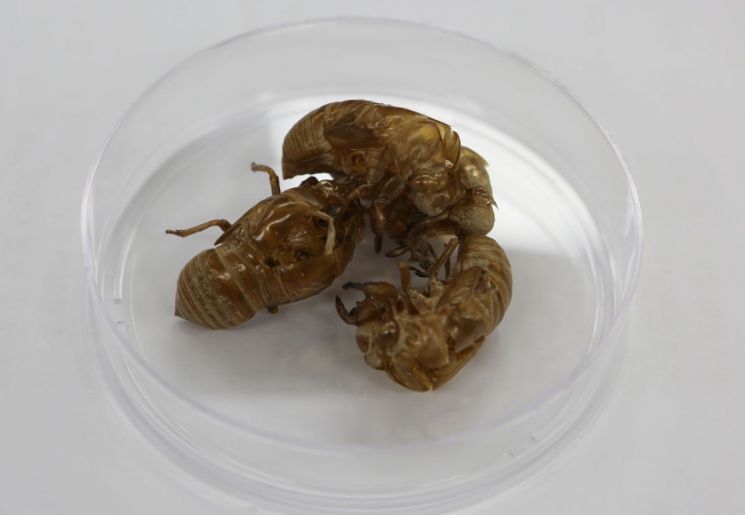
It has been scientifically proven by domestic researchers that cicada slough and Sen Tae (蟬退) extracts recorded in Donguibogam improve atopic dermatitis and clarified their mechanism of action.
On the 6th, Dr. Lim Hyesun's research team at the Herbal Medicine Resources Research Center of the Korea Institute of Oriental Medicine announced that they scientifically demonstrated the inhibitory effect of Sen Tae extract on atopic dermatitis and its mechanism of action through animal experiments.
The Korea Institute of Oriental Medicine has been conducting research to establish scientific evidence by experimentally verifying the therapeutic efficacy of insect-based medicinal materials, including insects and bugs, recorded in the insect section (Chungbu, 蟲部) of Donguibogam, which is attracting attention as a future food source.
As part of this, it was previously revealed through animal experiments that Sen Tae, recorded in Donguibogam as effective in improving convulsion and rigidity symptoms, improves behavioral disorders induced by Parkinson's disease.
Subsequently, the research team reinterpreted another efficacy of Sen Tae recorded in various traditional medical texts?treatment effects on skin diseases such as urticaria and itching?in a modern context, applying it to atopic dermatitis and conducting efficacy verification studies through animal experiments.
Traditional medical texts such as Donguibogam and Boncho Gangmok introduce cicada slough Sen Tae as treating skin diseases characterized by dulled skin sensation and severe itching symptoms.
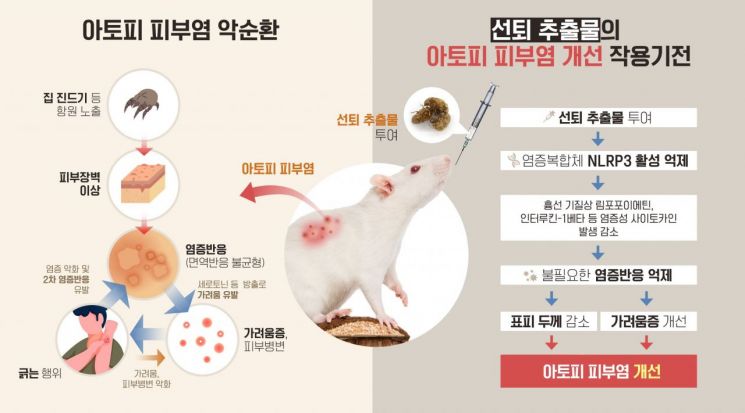
In animal experiments, Sen Tae extract was orally administered for six weeks to experimental mice induced with atopic dermatitis by applying house dust mites to their skin, and the degree of symptom improvement was observed.
As a result, in the pruritus behavior evaluation, the scratching time of the experimental group treated with Sen Tae extract averaged 33 seconds, which was more than twice suppressed compared to the control group's average of 69 seconds without treatment.
Also, the thickness of the stratum corneum, which had thickened from the normal level (18.60μm) to 116.60μm due to atopic dermatitis, was reduced to an average of 35.80μm in mice administered with Sen Tae extract, confirming that the skin became more than three times thinner again.
Furthermore, to confirm the mechanism of action for improving atopic dermatitis symptoms, the research team examined changes in immune responses occurring in the experimental mice.
As a result, the activity of the inflammatory complex NLRP3, which can cause excessive immune responses by misrecognizing danger signals from external factors, was alleviated by administering Sen Tae extract.
Accordingly, the expression of inflammatory cytokines such as thymic stromal lymphopoietin, interleukin-1 beta, interleukin-4, and interleukin-8, which are promoted during NLRP3 activation and induce inflammatory responses, decreased, confirming the mechanism by which atopic dermatitis symptoms improved.
NLRP3 promotes the production of inflammatory cytokines that transmit related cellular signals to trigger immune responses by recognizing danger signals such as external harmful substances. However, if NLRP3 mistakenly recognizes normal or very low risks as danger signals due to bodily abnormalities, it causes an excessive immune response.
Corresponding author Dr. Lim Hyesun said, “Topical steroids commonly used to treat atopic dermatitis can cause side effects such as secondary infections, so developing treatments with fewer side effects is essential. Clarifying the efficacy of Sen Tae, a natural herbal medicine with verified safety, in improving atopic dermatitis is highly meaningful.”
Moon Byungcheol, head of the Herbal Medicine Resources Research Center, stated, “Herbal medicine resources recorded in the insect section of Donguibogam, including insects and bugs, have great potential value. We will accelerate the development of safe and effective treatments for chronic intractable diseases based on herbal medicines with verified efficacy.”
Meanwhile, this achievement was conducted with the support of the Korea Institute of Oriental Medicine’s major projects under the Ministry of Science and ICT, and the research results were published in the latest issue of the SCI international journal Oxidative Medicine and Cellular Longevity (IF: 5.076).
© The Asia Business Daily(www.asiae.co.kr). All rights reserved.


















