'Economic Ripple Effects of Rising Oil Prices' Issue Analysis
"Very Strong Inflationary Pressure in Q2"
"Economic Growth Rate Expected to Rise from 3.1% to 3.8%"
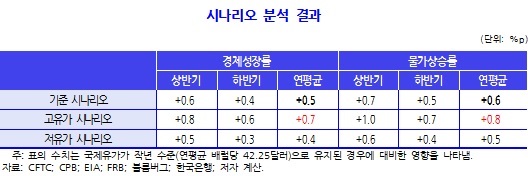
[Sejong=Asia Economy Reporter Moon Chaeseok] The Korea Development Institute (KDI) has assessed that this year’s rise in oil prices could cause the consumer price inflation rate to increase by up to 0.8 percentage points from the previously expected 0.7%. It forecasted strong inflationary pressure in the second quarter due to the base effect from low oil prices in the second quarter of last year. Prices of electricity bills and petroleum-related products may rise, and if the spread of COVID-19 does not subside, the government may need to introduce temporary household support policies.
In its policy analysis report titled "Recent Domestic Economic Ripple Effects of Rising Oil Prices," released on the 6th, KDI stated, "As international oil prices rebound, price pressures are expected to arise on essential living items such as petroleum products and electricity fees, whose production costs increase." It added, "If the spread of COVID-19 continues domestically and economic downturn occurs while international oil prices surge further, it is necessary to consider policy support that can temporarily reduce household burdens on products heavily affected by oil prices."
KDI projected that if oil prices rise to $70 per barrel this year, the inflation rate could increase by 0.5 to 0.8 percentage points, and the economic growth rate could rise by 0.4 to 0.7 percentage points. This means that the previously suggested inflation rate of 0.7% by KDI could rise to 1.5%, and the economic growth rate of 3.1% could increase to 3.8%. However, this analysis only reflects oil price fluctuations and does not consider other variables such as agricultural and livestock product prices or market concerns about inflation, according to KDI.
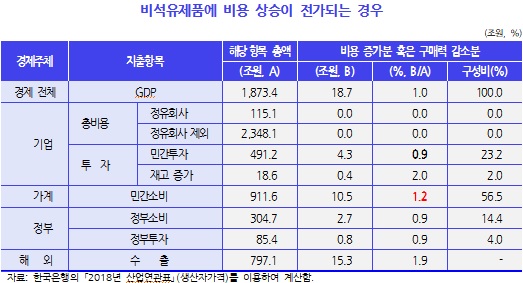
It is forecasted that if the international oil price (Dubai crude) rises to $60 per barrel, a 42.7% increase from last year’s average price of $42.25 per barrel, the overall purchasing power of the economy will decrease by about 1%. As corporate production costs increase, prices of non-petroleum products may rise, which could increase household consumption expenditure burdens by 0.3 to 1.2%.
Here, non-petroleum products include plastics containing synthetic resins and public transportation that uses petroleum products. These are goods closely related to consumers’ daily lives. If the scenario follows the high oil price trend as analyzed by KDI, it means that the already rising "shopping basket prices" could further strain the financially vulnerable.
Jung Kyu-cheol, head of KDI’s Economic Outlook Division, said, "In the second half of last year, we expected this year’s oil price to be in the $40 per barrel range, but due to complex reasons, prices have risen significantly now." He added, "Oil price increases naturally reflect on inflation, and since oil prices were very low in the second quarter of last year, strong inflationary pressure is expected in the second quarter of this year due to the base effect."
© The Asia Business Daily(www.asiae.co.kr). All rights reserved.



















