Stay in May This Month
Different from Usual Slowdowns in May
Stock Market Waiting Funds Also Abundant
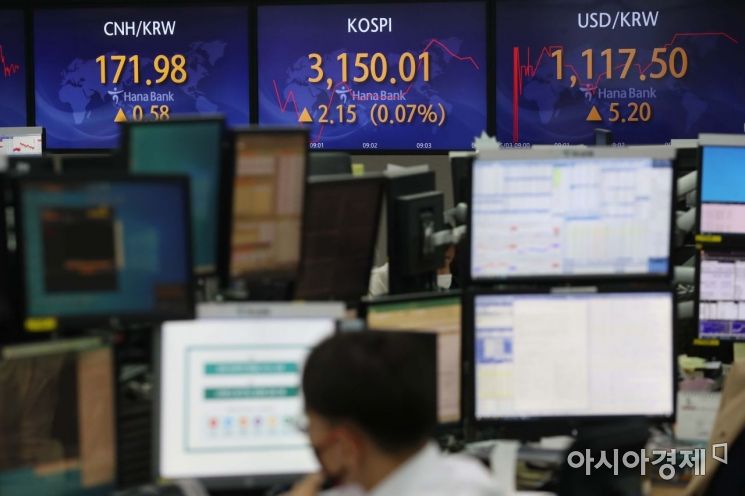 On the first day of the partial resumption of short selling on the 3rd, the KOSPI index is displayed on the electronic board in the dealing room of Hana Bank in Euljiro, Seoul. Photo by Mun Ho-nam munonam@
[Asia Economy Reporters Junho Hwang and Minwoo Lee] "Stay in May."
This is the perspective of the securities industry on the stock market this month. Typically, in May, the stock market tends to slow down, leading to the well-known U.S. market adage "Sell in May." However, this year, a different pattern is expected to unfold. Especially with the largest-ever level of standby funds in the market, this outlook is gaining strength.
Turnover Rate Hits Lowest This Year... An Optical Illusion

According to the Korea Financial Investment Association on the 6th, the deposit turnover rate on the 3rd was 33.52%, the lowest this year. The average daily turnover rate over the past month was about 43.02%. The deposit turnover rate is the ratio of deposits to daily trading volume, and a rate above 40% is considered the start of an overheated market.
Looking only at the turnover rate, it seems as if cold water has been poured over the stock market suddenly, but this is analyzed as a result of a sharp increase in deposits. On the 3rd, deposits reached 77.9018 trillion won, about 33% higher than the previous day's 58.4166 trillion won. This unusual increase in deposits was due to the refund of subscription deposits from SK IE Technology (SKIET) public offering, which had amassed a record-high margin of 81 trillion won. This can be seen as a significant increase in funds to be injected into the stock market.
However, since these funds have not yet flowed into the market, the turnover rate appears to have plummeted. On the 4th, the KOSPI daily trading volume was 15.9624 trillion won, down from 16.9758 trillion won the previous day. During the same period, KOSDAQ trading volume remained in the 9 trillion won range. This is analyzed as an impact of weakened investor sentiment following the resumption of short selling from the 3rd. Additionally, the rapid growth of the cryptocurrency market and the increased possibility of interest rate adjustments due to U.S. inflation have narrowed the channels for these funds to flow into the stock market.
Stay in May This Month

In this regard, the securities industry expects these funds to circulate positively within the stock market. The impact of short selling is expected to be limited. The resumption of short selling is seen as a short-term supply-demand disruption factor and a variable that may increase volatility in individual stocks. Rather, the market may rise further. Currently, the inflation rate increase is likely to be less than feared, and even that can be seen as a temporary rise due to the base effect of oil prices.
It is also a possible time for overseas capital inflows with some time lag. Bond yields have already factored in variables such as inflation expectations in the first quarter of this year, monetary policy uncertainty, supply-demand instability, and expanded bond issuance, so market experts diagnose that bond yields will rather stabilize. Accordingly, Samsung Securities has set the expected upper limit of the KOSPI this month at 3,300, and Daishin Securities expects the KOSPI to rise up to 3,380 this month.
Lee Kyung-min, a researcher at Daishin Securities, said, "As the price distortion phenomenon where spot prices are higher than futures prices eases, it is expected to have a positive effect on large-cap stock supply and demand," adding, "The weak U.S. dollar is another variable that will improve foreign investor supply and demand." He further analyzed, "The possibility that the market adage 'Sell in May and go away,' which stirs investors' anxiety, will materialize is low," and "The expansion of inflationary pressure and the resumption of short selling will not have a significant impact on the global stock market and the KOSPI's upward trend."
In the past five years, the "Sell in May and go away" phenomenon has appeared intermittently in the KOSPI market. In May 2016, the KOSPI fell by 0.54%, but in May of the following year, it rose by 6.44%. Then, in 2018 and 2019, it fell by 3.67% and 7.34%, respectively, realizing the adage. However, after the direct hit of COVID-19, a strong rebound occurred last year with a 4.21% increase.
Kim Yong-gu, a researcher at Samsung Securities, said, "There is no practical benefit to the 'Sell in May' skepticism," and "The market's character will not change immediately."
© The Asia Business Daily(www.asiae.co.kr). All rights reserved.



















