Mayor Oh Se-hoon's Claim to Include Childcare Centers in Free Meals
Seoul Metropolitan Office of Education Prefers Kindergarten Priority and Gradual Expansion
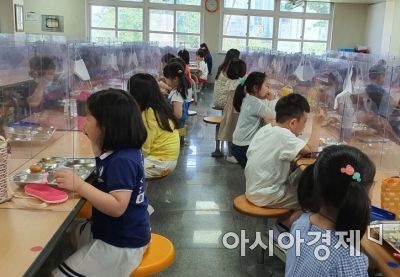 Children are eating in a cafeteria with partitions installed. (Photo unrelated to the article content)
[Asia Economy Reporter Han Jinju] Seoul Mayor Oh Se-hoon has accelerated the push for free kindergarten meals by accepting the Seoul Metropolitan Office of Education's proposal. However, there is a difference in stance between the city and the education office regarding whether to include daycare centers.
According to the Seoul Metropolitan Office of Education on the 6th, the results of a research project on appropriate meal costs per child commissioned by the office will be released by the end of this month. After Mayor Oh's announcement on promoting free kindergarten meals on the 4th, the education office proposed discussions among working-level staff and plans to discuss the related budget based on the meal cost research results.
An official from the education office explained, "Once the research results are out, it will be possible to estimate how much the meal cost should be set depending on the number of children and scale. Although 2023 is the target year, if consultations with Seoul City proceed quickly, it is possible to advance the introduction by one year."
Currently, meal costs and the application standards for the Nuri Curriculum meal fees differ by kindergarten type, resulting in differences in parental burden and meal quality. According to the education office's survey, the average meal cost per kindergarten is set at 3,100 KRW. The meal costs by kindergarten type are ▲Private 2,832 KRW ▲Single-establishment public 3,004 KRW ▲Attached public 3,501 KRW.
In national kindergartens, 80,000 KRW is supported for meal fees under the Nuri Curriculum, whereas private kindergartens use the Nuri Curriculum subsidy for educational activity program fees and charge most of the meal fees to parents. Parents bear 96% of meal costs in private kindergartens and 19% in public single-establishment kindergartens. Among Seoul's private kindergartens with fewer than 100 students, 256 are not subject to the School Meals Act. They are also not subject to mandatory placement of nutrition teachers or management standards. With the introduction of free meals, it will be possible to support labor costs as well, reducing disparities by kindergarten size and type.
However, while Mayor Oh insists on including daycare centers, the education office prefers prioritizing kindergartens and gradually expanding to daycare centers. An education office official said, "Daycare centers are under the jurisdiction of the Ministry of Health and Welfare, so coordination at the city or provincial level will be difficult," adding, "Meal costs for daycare centers are included in childcare fees, and selective focus on free kindergarten meals is necessary."
Budget sharing between Seoul City and the education office is also a topic of discussion. As of August 2020, the education office estimated the average unit cost for free meals, including food, management, and labor costs, at 6,192 KRW. Providing meals for 180 days is analyzed to cost about 83.4 billion KRW. Currently, free meals for elementary, middle, and high schools are funded at a ratio of 5 (education office): 3 (city): 2 (district). Superintendent Cho Hee-yeon also stated, "Considering the financial situation of autonomous districts, there is a possibility of discussing phased implementation plans."
© The Asia Business Daily(www.asiae.co.kr). All rights reserved.
![Clutching a Stolen Dior Bag, Saying "I Hate Being Poor but Real"... The Grotesque Con of a "Human Knockoff" [Slate]](https://cwcontent.asiae.co.kr/asiaresize/183/2026021902243444107_1771435474.jpg)
















