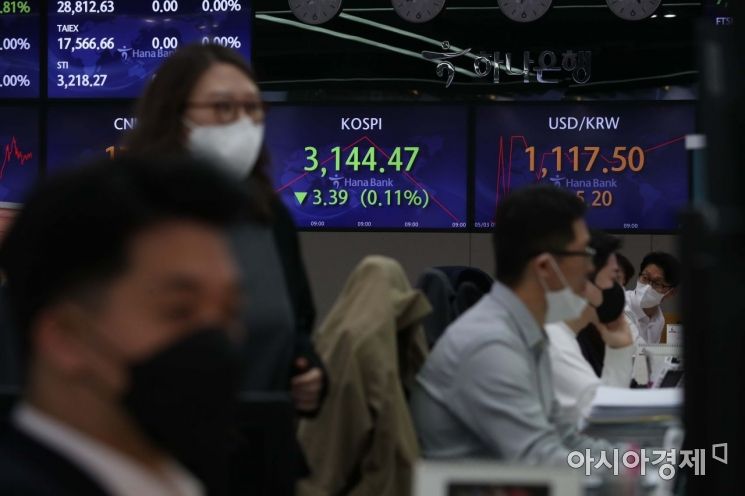
[Asia Economy Reporter Ji Yeon-jin] The power of short selling was greater than expected. On the first day of the resumption of short selling after 14 months, on the 3rd, the stock index was dragged down as pharmaceutical and bio stocks, including Celltrion, plunged sharply. As bio stocks, which had surged significantly during the high-flying period of the domestic stock market since COVID-19, became the main target of short selling, investors' attention is focused on the future stock price trends.
According to the Korea Exchange Short Selling Portal on the 4th, short selling worth approximately 829.6 billion KRW was conducted on KOSPI 200 stocks the previous day. The short selling transaction amount for KOSDAQ 150 was 279.3 billion KRW, with over 1 trillion KRW flowing into short selling. In particular, this short selling was centered on bio stocks.
◆ Concentrated fire on bio stocks= In KOSPI 200, short selling worth about 145.7 billion KRW was conducted in the healthcare sector, accounting for the largest share, and nearly half of the short selling funds in KOSDAQ 150, 112.1 billion KRW, were concentrated in the healthcare sector.
This short selling, combined with investor fear, caused bio stock prices to fall sharply. In KOSPI 200 stocks, Boryung Pharmaceutical and Shinpung Pharmaceutical recorded the largest declines, falling 12.55% and 12.18%, respectively. Celltrion, which has the largest short selling balance in KOSPI, fell 6.2%, and Samsung Biologics also dropped 3.86%. In KOSDAQ 150, Ace Tech, a telecommunications equipment company, plunged 12.53%, recording the largest drop, followed by bio-pharmaceutical companies Helixmith and Huons, which fell 10.59% and 10.58%, respectively. Celltrion Healthcare, the leading stock in KOSDAQ, also fell 5.97%.
The Korea Exchange designated 22 stocks, including Ace Tech, Boryung Pharmaceutical, and Shinpung Pharmaceutical, as ‘short selling overheated stocks’ and excluded them from short selling transactions for the day. This includes 4 KOSPI stocks and 18 KOSDAQ stocks. Among them, 13 are pharmaceutical and bio stocks: Green Cross LabCell, LegoChem Bio, Boryung Pharmaceutical, Samchundang Pharmaceutical, Shinpung Pharmaceutical, Antrogen, ST Pharm, NK Max, Genexine, Kolmar BNH, Telcon RF Pharmaceutical, Hyundai Bio, and Huons.
◆ Short selling shock is temporary and limited= The financial investment industry initially expected the impact of this short selling on the stock market to be limited. However, a temporary price decline was anticipated for stocks with excessively high price levels relative to corporate value. In fact, pharmaceutical and bio stocks, regarded as ‘COVID-19 beneficiary stocks,’ surged sharply during the rising market over the past six months. On the previous day, KOSPI and KOSDAQ fell 0.66% and 2.20%, respectively, while the daily returns of short selling targets KOSPI 200 and KOSDAQ 150 were -0.5% and -3.1%, respectively. The industry interpreted the larger decline in KOSPI compared to KOSPI 200 as indicating that the impact of short selling was limited.
Experts forecast that, as initially expected, the trend of rising domestic stock markets will continue. In the past, when short selling was banned and then resumed in 2009 and 2011, stock prices fell 5% and 6% from the pre-resumption highs, respectively, but at that time, external negative factors such as North Korea’s nuclear tests (2009) and the European debt crisis (2011) severely impacted the market. Since there are no such external negative factors currently, the market shock from the resumption of short selling is expected to be limited.
Ha In-han, a researcher at KB Securities, said, "The cause of this market correction is attributed to the resumption of short selling," adding, "With no external negative factors, the market is judged to have already entered a bottom phase." Researcher Ha added that the buying point is from the low 3100s, which is a 3.75% drop from this year's KOSPI high (3220.82). Bae Han-joo, a researcher at Mirae Asset Securities, said, "Although individual investors’ sentiment may be uneasy, the possibility that the resumption of short selling will lead to a price decline remains low," adding, "We need to observe the market trend a little longer going forward."
© The Asia Business Daily(www.asiae.co.kr). All rights reserved.

















